
This content is for informational purposes and does not constitute tax or legal advice. Credit unions and borrowers should consult current IRS guidance and qualified advisers.
Key takeaway: OBBBA auto loans for credit unions are supported by VIN-based vehicle data that helps lenders screen key vehicle requirements earlier in the lending journey. Faster answers on final assembly, vehicle type, and weight class can reduce manual research, help dealers move qualified applications forward, and give members clearer guidance at the point of purchase.
Why OBBBA Creates an Auto Lending Opportunity
The One Big Beautiful Bill Act created a temporary federal deduction for qualified passenger vehicle loan interest. For tax years 2025 through 2028, eligible taxpayers may deduct up to $10,000 in qualifying interest, whether or not they itemize.
As a result, the deduction can influence how members compare vehicles and financing. A credit union that can quickly explain which vehicle and loan requirements appear to be met becomes more useful during that decision, not only after the loan closes.
Under current IRS guidance on the car loan interest deduction, a qualifying vehicle must be new, purchased for personal use, have a gross vehicle weight rating under 14,000 pounds, and undergo final assembly in the United States. The loan itself must also meet several conditions:
- Originate after December 31, 2024
- Finance a new vehicle whose original use begins with the taxpayer
- Be secured by a first lien on the vehicle
- Be for personal rather than business use
The deduction also begins to phase out once modified adjusted gross income exceeds $100,000 for individual filers or $200,000 for joint filers. Vehicle eligibility, loan eligibility, and borrower eligibility are three separate checks, and all three should be part of any screening workflow.
Where VIN Data Supports Indirect Auto Lending
In indirect auto lending, speed and certainty shape the dealer experience. VIN-based OBBBA vehicle screening can surface relevant attributes, including assembly location, sourced from manufacturer-reported data such as the NHTSA VIN Decoder, during submission, before a loan officer or dealer begins a manual lookup.
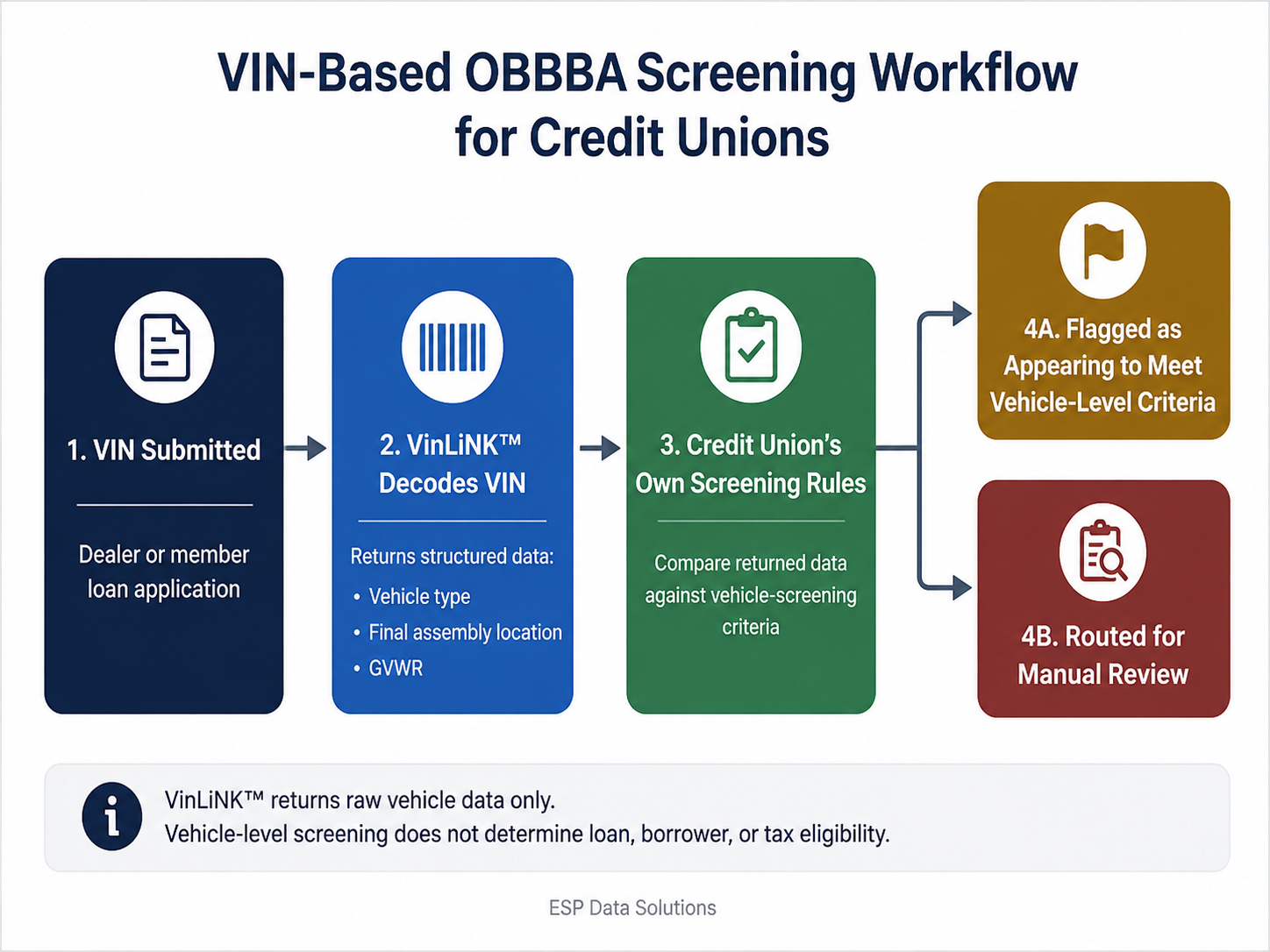
Example workflow: A dealer submits a VIN as part of a loan application. VinLiNK™ returns structured vehicle attributes, including vehicle type, assembly location, and GVWR, to the credit union’s loan-origination workflow. The credit union’s own screening rules then compare those attributes against vehicle-screening criteria and either flag the vehicle as appearing to meet vehicle-level criteria or route the application for manual review.
Dealer loan submission
Flag vehicle-level qualification factors earlier.
Loan officer review
Reduce manual research into assembly location, vehicle type, and weight class.
Member prequalification
Explain vehicle requirements before the member commits to a purchase.
As a result, the workflow creates a smoother handoff among the dealer, lender, and member, and a practical way for credit unions to differentiate their indirect lending programs without changing credit policy.
What a VIN Can and Cannot Confirm
VIN data should be treated as one part of the eligibility process. It can help evaluate final assembly, vehicle type, and gross vehicle weight rating, but it cannot determine whether a borrower meets income limits, whether a vehicle purchase qualifies as personal use, or whether a loan satisfies every statutory requirement. Credit unions should align disclosures and workflows with current IRS guidance and qualified tax or legal counsel. For a deeper look at how these vehicle attributes are used across lending and reporting workflows, see ESP’s guide to OBBBA auto loan reporting and Form 1098-VLI.
OBBBA Auto Loans for Credit Unions: Putting VIN-Based Vehicle Data to Work
- Screen at application: add VIN decoding to direct and indirect loan intake
- Return clear results: show relevant vehicle attributes and route exceptions for review
- Equip member-facing teams: give loan officers consistent language that separates vehicle screening from final tax eligibility
- Plan for reporting: coordinate vehicle and loan records with current IRS information-reporting requirements, including Form 1098-VLI when applicable
Use VinLiNK™ in Your Auto Lending Workflow
VinLiNK™ from ESP Data Solutions delivers structured VIN decoding through a web API. Credit unions and their technology partners can integrate vehicle data into loan-origination, dealer, underwriting, and member-facing systems.
Talk with ESP Data Solutions about the VIN fields, integration options, and screening logic needed for your direct or indirect auto lending workflow. Contact us or email sales@espdata.com.
Frequently Asked Questions
Can a VIN confirm OBBBA vehicle eligibility?
It can screen vehicle-level requirements, including final assembly location, vehicle type, and GVWR. Borrower, loan, and tax eligibility must be evaluated separately.
Where can credit unions use OBBBA vehicle data?
Common integration points include dealer submissions, direct loan applications, loan-origination systems, prequalification experiences, and member-facing tools.