
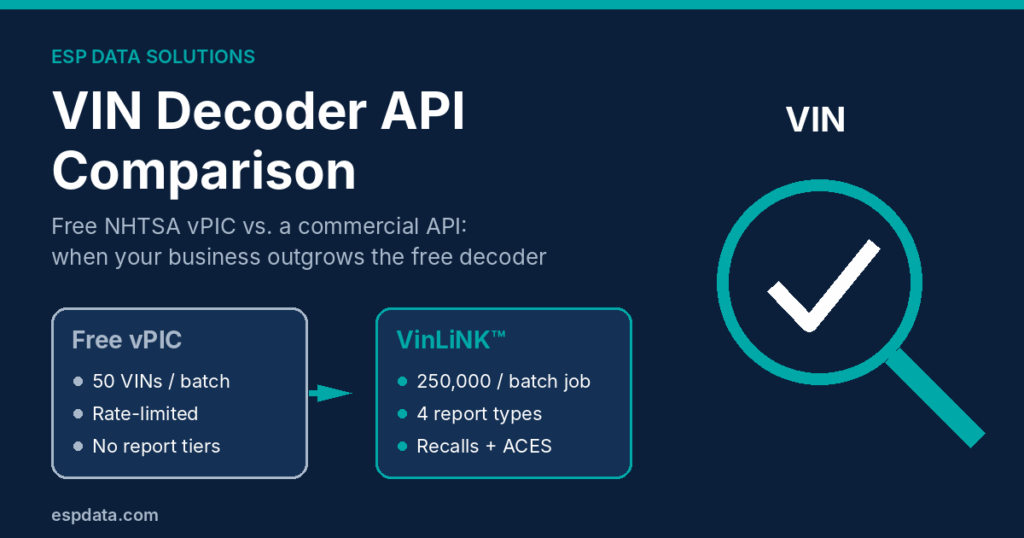
Vehicle-data teams often face the same decision: is the free government decoder enough, or does the workflow require a commercial API? This VIN decoder API comparison gives you a practical answer. We’ll look at what the free NHTSA vPIC API does well, the signs that your business has outgrown it, and the checklist we recommend before you sign up with any provider, ESP Data Solutions included.
Quick Answer
- Use the free NHTSA vPIC API for prototypes, research, and low-volume lookups where the public vPIC data set covers what you need and you don’t require account-level support.
- Choose a commercial VIN decoder API like VinLiNK™ when you need high-volume batch decoding, tiered report options, recall data in the same workflow, ACES vehicle mapping, and account-level email support with VIN data conflict resolution.
What the Free NHTSA vPIC API Does Well
NHTSA’s vPIC API is a genuinely useful public resource. Its dataset is built from the VIN-assignment information manufacturers submit to NHTSA under 49 CFR Part 565. It offers several decoding methods, returns data in XML, CSV, or JSON, supports partial VINs, and costs nothing to use. NHTSA also publishes standalone vPIC databases for download.
For a developer testing an idea, or a small shop decoding a handful of VINs a day, that’s a strong starting point. From there, VIN data providers differ in the sources they use and in how they validate, normalize, supplement, update, and support their data.
Five Signs You’ve Outgrown the Free Decoder
As volume and stakes grow, most teams hit the same limits:
- Volume. vPIC’s batch endpoint accepts up to 50 VINs per request, and NHTSA applies automated traffic rate controls. Decoding a 20,000-vehicle portfolio or a nightly auction feed becomes a queueing project. NHTSA also offers standalone SQL Server and PostgreSQL databases that avoid the public API’s quotas and rate limits. That can work well for high-volume decoding, but your team must host and update the database, and the standalone version is limited to VIN decoding.
- Depth. Underwriters, lenders, and fleet managers often need weights, dimensions, warranty, and MSRP, not just the core VIN fields.
- Recalls in one call. vPIC focuses on decoding. Recall lookups live in a separate NHTSA tool, so your workflow needs a second integration.
- Catalog mapping. Parts sellers and repair shops need VIN results mapped to industry standards like ACES, so vehicles connect cleanly to their parts catalogs.
- Support. NHTSA provides public documentation and a manufacturer helpdesk. However, it doesn’t offer the account-level support a commercial data provider gives you when a decode looks wrong and a customer is waiting.
VIN Decoder API Comparison: Side by Side
- Cost: NHTSA vPIC: Free. VinLiNK™: Pay-as-you-go, no contracts or monthly fees.
- Data foundation: NHTSA vPIC: Manufacturer submissions to NHTSA. VinLiNK™: Manufacturer submissions to NHTSA, plus additional manufacturer technical documents.
- Batch volume: NHTSA vPIC: Up to 50 VINs per request. VinLiNK™: Up to 250,000 VINs per batch job, according to ESP Data Solutions.
- Report options: NHTSA vPIC: Several decoding methods; no tiered report packages. VinLiNK™: Four reports: Basic, Basic Plus, Enhanced, Recall.
- Recalls: NHTSA vPIC: Separate NHTSA recall data. VinLiNK™: Recall Report in the same API.
- Catalog mapping: NHTSA vPIC: Not included. VinLiNK™: ACES vehicle mapping.
- VIN handling and validation: NHTSA vPIC: Supports full and partial VIN decoding and returns error information. VinLiNK™: Checks VINs against ISO 3779 and NHTSA VIN requirements; batch pre-validation available.
- Output: NHTSA vPIC: XML, CSV, JSON. VinLiNK™: JSON, XML, PDF.
- Deployment: NHTSA vPIC: Public cloud API or downloadable database. VinLiNK™: Cloud API; separate VinPOWER product available for on-premises deployment.
- Updates and support: NHTSA vPIC: Public documentation and manufacturer helpdesk. VinLiNK™: Weekly data updates, email support, VIN data conflict resolution.
Details verified October 14, 2026, against the NHTSA vPIC API documentation and standalone database page, the VinLiNK™ product page, the VinLiNK™ overview, and the VinLiNK™ API documentation. Limits and features can change, so confirm with each provider before you integrate.
ACES vehicle mapping supports a parts-catalog workflow. Final fitment still depends on your catalog’s application data and matching rules, as described by the Auto Care Association.
Your 2026 Checklist for Choosing a VIN Decoder API
Before you commit to any provider, ask these questions:
- How far back does coverage go? VinLiNK™ covers model year 1981 onward, which matters for auctions, salvage, and lending portfolios with older vehicles.
- Can it handle your peak volume? Ask about batch limits, not just per-call speed. ESP’s VIN batch decoding service is built for portfolio-sized jobs.
- Does it validate the VIN itself? VinLiNK™ checks VINs against ISO 3779 and NHTSA VIN requirements, helping identify malformed VINs and other validation failures before those records move downstream. For batch jobs, validation runs first and reports how many VINs are valid and invalid before any charges apply.
- What happens when something goes wrong? Ask every provider about authentication, error codes, response times, service commitments, and data retention. Clear answers can prevent avoidable integration delays and unexpected operating constraints.
- Can you start with plates instead of VINs? If your team often sees a license plate first, ESP’s Plate-to-VIN API can help convert a U.S. plate to a VIN (match rates vary by state and record availability).
- Does it fit your infrastructure? Cloud API not an option? VinPOWER runs on-premises for .NET and Java environments.
- Is pricing predictable? Look for no annual license fees and no lock-in. VinLiNK™ works on prepaid funds with a $100 minimum top-up.
- Can you test with your own VINs first? A free testing account tells you more than any sales page.
Who Benefits Most from Switching
Teams usually move to a commercial API when VIN data starts driving revenue or risk decisions. That includes dealers managing inventory, insurance underwriters, lenders reviewing loan portfolios, fleets onboarding vehicles in bulk, and parts sellers building Year/Make/Model selectors.
Frequently Asked Questions
Is the NHTSA VIN decoder API really free?
Yes. NHTSA’s vPIC API is free to use and is a solid choice for testing and low-volume lookups. For high-volume or business-critical work, a commercial VIN decoder API adds batch capacity, extra report options, and support.
Can I try VinLiNK™ before paying?
Yes. ESP Data Solutions offers a free testing account so you can decode your own VINs and review the reports. Contact our team to set it up.
How many VINs can VinLiNK™ decode at once?
ESP states that VinLiNK™ can process batch jobs of up to 250,000 VINs. You submit a VIN list or file, and you retrieve the results once processing is complete. That makes it a strong fit for auctions, lenders, insurers, and large fleets.
Does VinLiNK™ include recall information?
Yes. The Recall Report combines Basic vehicle data with manufacturer recall and safety campaign information, so you can access vehicle details and recall information in one workflow. If you need VIN-specific unrepaired-recall status, confirm that requirement with ESP before you integrate.
What does a VIN decoder API comparison usually miss?
Most comparisons focus on price per call. Data validation, batch limits, report depth, and support deserve equal attention, because they also shape implementation and operating costs.
Ready to Compare for Yourself?
The best VIN decoder API comparison is one you run on your own data. Try our free online VIN decoder for a quick look, then request a free VinLiNK™ testing account or call (978) 975-3333. ESP Data Solutions has provided vehicle data for more than 30 years, and VinLiNK™ has decoded more than one billion VINs.