
Dealers are adding AI tools for marketing, service reminders, and customer follow-up at a fast pace. However, those tools can only work with the records they’re given. Dealership VIN data cleanup uses decoded VIN data to identify and correct missing or inconsistent year, make, model, trim, and engine fields in CRM and DMS records, so campaigns and AI tools start from more accurate vehicle data.
Quick Answer
- Dealership VIN data cleanup starts with the VINs you already have. Incomplete or mistyped vehicle fields in your CRM and DMS can send the wrong offers to the wrong customers, and AI tools can repeat those mistakes at scale.
- VinLiNK™ decodes the VINs you already have and returns standardized vehicle data, one record at a time or in batch jobs of up to 250,000 VINs, according to ESP Data Solutions. Your CRM, DMS, or integration process then updates the matching records.
- Batch validation identifies valid and invalid VINs before decoding begins, so you can review your file before incurring decoding charges.
Why Dealership VIN Data Cleanup Matters Now
Industry voices are raising the same warning. In AM Online, Auto Data Solutions cautioned that dealers adopting AI-powered marketing may be disappointed if their customer databases contain a high share of inaccurate records. Similarly, a July 2026 Digital Dealer article noted that many dealership databases have duplicate profiles, outdated contact information, and incomplete vehicle ownership data spread across multiple systems.
The problem isn’t new. In a 2023 PureCars survey reported by CBT News, only 13% of dealers felt their DMS was populated with clean data. What has changed is the cost of ignoring it, because automated tools now act on those records every day.
Where Dealership VIN Data Cleanup Fits
1. Filling Missing Vehicle Fields
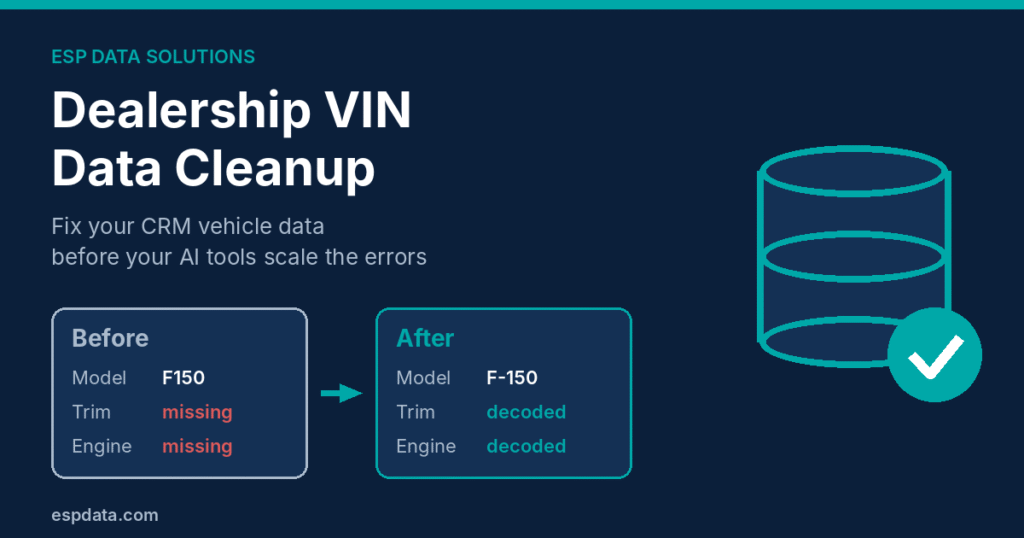
Service and sales records often hold a VIN but leave the model, trim, or engine blank or typed by hand. Decoding the VIN returns standardized values your integration can write back, so “F150,” “F-150,” and “Ford F 150” can become one consistent model name.
2. Catching Bad VINs Early
A single mistyped character can break a record. VinLiNK™ batch validation helps identify invalid or improperly formatted VINs before decoding, allowing your team to review problematic records first.
3. Enriching Vehicle Records in Bulk
Large dealer groups can hold hundreds of thousands of vehicle records. With bulk VIN decoding, you submit a file and retrieve the results once processing is complete. VinLiNK™ covers model years 1981 and newer, and field availability varies by vehicle, model year, source data, and report tier.
4. Recall Outreach to Service Customers
The VinLiNK™ Recall Report adds manufacturer recall and safety campaign information to decoded vehicle data. Running it across your service database helps your team plan recall outreach, the same approach we describe for dealer recall checks. Recall data identifies associated manufacturer campaigns; it doesn’t necessarily confirm whether a repair has been completed. Confirm VIN-specific open-recall status through an appropriate recall-status source before sending targeted recall notices.
5. Warranty-Based Service Offers
The Basic Plus report adds manufacturer warranty and MSRP data. As a result, your team can plan service-contract or maintenance offers around factory coverage, combined with the mileage and in-service date in your own records. Our article on VIN decoding for service contracts explains this workflow.
6. Better Data for AI Agents and Chatbots
AI voice agents and chatbots answer customers using the vehicle data they can see. Clean, decoded records help them identify the right vehicle, as we explain in our AI agent VIN lookup article. And when a customer only knows a license plate, Plate-to-VIN can return the matching VIN with no owner information. A lookup may return no match, so keep a VIN-entry fallback.
Dealership VIN Data Cleanup Example: Before and After
Illustrative example, not an actual API response.
- Before decoding: Make “Ford,” Model “F150,” Trim missing, Engine missing.
- After decoding: Make “Ford,” Model “F-150,” with trim and engine filled in when that data is available for the VIN.
- Final step: Your CRM or integration process uses the returned data to update the matching vehicle fields.
Developers can review request and response formats in the VinLiNK™ API documentation.
What VinLiNK™ Provides and What Needs Another Source
- Year, make, model, trim, and engine: VinLiNK™ provides standardized information where available. The level of detail depends on the VIN, model year, source data, and selected report.
- Manufacturer warranty and MSRP (Basic Plus): VinLiNK™ provides them. Mileage and in-service date come from your records.
- Recall campaigns (Recall Report): VinLiNK™ provides them. Open-recall status for a specific VIN needs a separate check.
- Current ownership: Your CRM and other data sources handle it. Roughly 45 million vehicles change owners each year, according to Dealer Marketing, so a decoded VIN doesn’t prove the customer still has the car.
- Duplicate customer profiles: Your CRM or data platform merges them. Standardized vehicle data makes those matches easier.
Which VinLiNK™ Report Fits Dealership VIN Data Cleanup?
- Basic ($0.20 per report): Year, make, model, and trim data, NHTSA-required manufacturer data, and ACES mapping. The usual starting point for a cleanup.
- Basic Plus ($0.25 per report): Everything in Basic, plus dimensions and weight, manufacturer warranty, and MSRP.
- Enhanced ($0.50 per report): Everything in Basic, plus technical specs and standard and optional equipment.
- Recall ($0.25 per report): Everything in Basic, plus manufacturer recalls.
Prices are taken from the VinLiNK™ pricing page as of November 2026, and prices and terms may change. Accounts work on prepaid funds with a $100 minimum deposit, and funds need to be used within a year. If your data must stay inside your own network, VinPOWER is ESP’s separate on-premises decoder for .NET and Java environments.
Frequently Asked Questions
Can dealership VIN data cleanup cover our whole database?
Yes. ESP states that VinLiNK™ can process batch jobs of up to 250,000 VINs. You submit a file of VINs and retrieve the decoded vehicle data once processing is complete. Contact details, duplicate customer profiles, and system syncing stay with your CRM or data platform.
Will we pay for invalid VINs in our file?
Batch validation identifies valid and invalid VINs before decoding begins, so you can review your file and fix or remove bad records before incurring decoding charges.
Can VIN decoding help our AI marketing tools?
Yes. Decoded, standardized vehicle fields give AI tools a cleaner starting point. Customer contact data, ownership, and duplicate profiles still need to be maintained in your CRM.
Can we use the data for recall campaigns?
Yes. The Recall Report adds manufacturer recall and safety campaign information, which helps your team plan outreach to service customers. Confirm VIN-specific open-recall status through an appropriate source before contacting customers about outstanding recalls.
Can we test dealership VIN data cleanup on our own records first?
Yes. ESP Data Solutions offers a free testing account, so you can decode a sample of your own CRM or DMS records and review the results before you commit.
Test VinLiNK™ With Your Dealership VIN Data
Dealership VIN data cleanup gives your CRM, DMS, and AI tools a more consistent vehicle record to work from. Request a free VinLiNK™ testing account and test it with a sample of your own dealership VINs, or call ESP Data Solutions at (978) 975-3333. ESP has provided vehicle data for more than 30 years, and VinLiNK™ has decoded more than one billion VINs.
Product details and sources last reviewed: November 2026.