
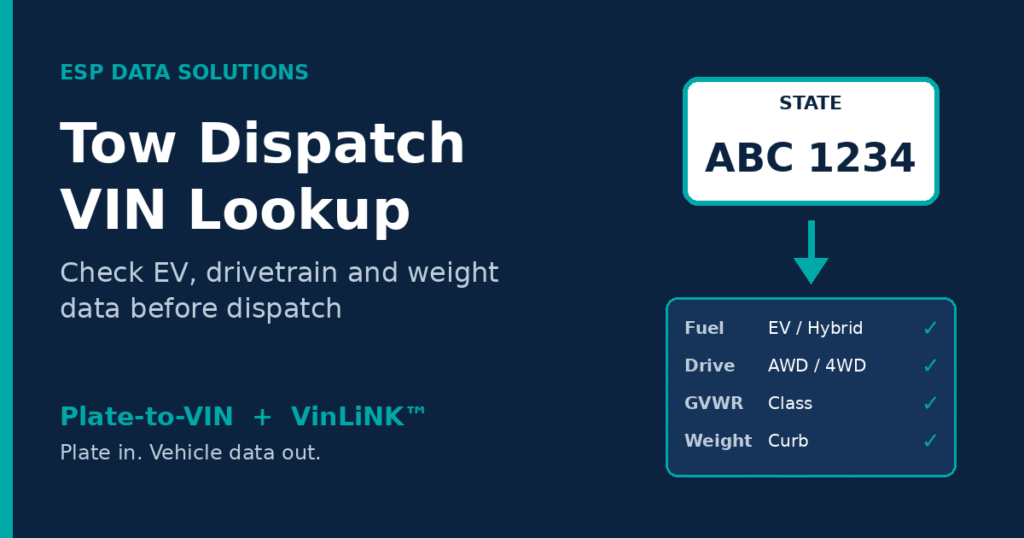
A tow call usually starts with very little information: a location, a phone number and a description like “a gray SUV.” A tow dispatch VIN lookup changes that. The caller gives a license plate, and when a match and source data are available, the dispatcher can see within moments whether the vehicle is electric, hybrid or all-wheel drive, along with its GVWR class, before a truck leaves the yard.
ESP Data Solutions has supplied vehicle data to the automotive industry for more than 30 years. Here is how Plate-to-VIN and VinLiNK™ help towing companies, roadside assistance providers and dispatch software platforms assess truck and equipment needs before assignment.
Why the Wrong Truck Is an Expensive Mistake
Every towing company knows the cost of a wasted trip: fuel, driver time, a delayed customer and a second truck sent to finish the job. That risk is growing as the vehicles on the road change.
Electric vehicles are the clearest example. Towing requirements vary by model, but many EV manufacturers recommend flatbed transport. Ford, for example, recommends a flatbed tow truck for a disabled Mustang Mach-E. As Midtronics explains, in many EVs the motor stays connected to the drive wheels even in neutral, so spinning wheels can make the motor act like a generator and push voltage into the high-voltage system. The dispatcher’s job is to identify the vehicle quickly, then apply the manufacturer’s towing instructions.
AWD and 4WD vehicles often need a flatbed or wheel dollies as well, depending on the manufacturer’s towing instructions. Hyundai’s owner’s manual, for example, states that AWD vehicles must be towed with a wheel lift and dollies or flatbed equipment with all the wheels off the ground. Heavier vehicles may need a larger truck than their size suggests. When dispatch guesses wrong, the truck can arrive unable to take the vehicle and return empty.
How Tow Dispatch VIN Lookup Works
ESP’s tools fit behind a dispatch screen, a roadside assistance app or a motor club intake form:
- The caller gives a plate and state. The caller may not need to locate the windshield VIN, which is especially useful when they are standing on a busy roadside.
- Plate-to-VIN returns the matching VIN when a match is available. In ESP testing, the plate-matching step typically completed in about two seconds.
- VinLiNK™ decodes the VIN into the details dispatch needs.
- The dispatcher confirms the vehicle with the caller and uses the confirmed vehicle data and manufacturer instructions to select the truck and equipment.
When no VIN is on record for a plate, the API returns a clear no-match response, and the dispatcher can ask for the VIN or use a year/make/model selector powered by ESP Year Make Model Tables.
What Tow Dispatch VIN Lookup Tells Your Dispatcher
VinLiNK™ returns the vehicle details that matter most for tow planning:
- Fuel and hybrid type: gasoline, diesel, electric (EV), hybrid or plug-in hybrid, so EVs are flagged before the truck is assigned.
- Drive type: AWD, 4WD, FWD or RWD, to help decide between a flatbed, wheel-lift or dollies.
- GVWR class: included in the Basic report, showing the gross vehicle weight rating range the vehicle falls into. Where the manufacturer provides it, a narrower GVWR production range is also included.
- Curb weight, specific GVWR and dimensions: often available in the Basic Plus report where source data supports them, especially for newer model years.
- Year, make, model, trim and body style: so the dispatcher and driver have a clearer vehicle description before arrival.
This article focuses on passenger cars, vans, SUVs and pickups. VinLiNK™ supports additional vehicle classes, but field availability varies by vehicle type and report tier.
Custom Data Mapping for Special Towing Requirements
Standard vehicle attributes may not capture every customer-specific equipment rule. In one anonymized ESP customer project, a towing company found that its standard dispatch rules assigned an undersized truck for a particular electric delivery van, so trucks were returning empty. ESP mapped that model to a higher, customer-defined dispatch-equipment class. This operational classification did not change the manufacturer’s GVWR or vehicle class.
ESP’s Custom Data Mapping service can help clients add verified fields or classifications that their dispatch logic depends on.
What ESP Provides — and What Your Team Decides
- ESP Plate-to-VIN: converts a plate and registration state into the matching VIN. It returns vehicle data only, with no owner name, address or other personal information.
- ESP VinLiNK™: returns available fuel type, drive type, GVWR class, weights and other specifications in JSON or XML.
- Your dispatch team and procedures: apply the manufacturer’s towing instructions, choose the truck and equipment, and confirm details on scene.
In short, ESP provides available vehicle data; your team makes the towing decision.
Who Can Use Tow Dispatch VIN Lookup
- Towing and recovery companies dispatching light-duty and medium-duty trucks
- Roadside assistance providers and motor clubs handling high call volumes
- Towing and dispatch software platforms adding vehicle intelligence to their products
- Impound and private-property towing operators documenting vehicles accurately
- Fleet and rental companies arranging recovery for their own vehicles
For manifests, impound logs and other large lists, see our guide to batch VIN decoding for vehicle shipping and towing companies and our Shipping & Towing industry page.
Getting Started with ESP Data Solutions
Plate-to-VIN and VinLiNK™ can be integrated into an existing dispatch workflow through standard APIs. Implementation requirements depend on the dispatch platform. VinLiNK™ is pay-as-you-go with no contracts or annual license fees, vehicle data updates weekly, and ESP offers a free testing account so you can try real plates and VINs before going live.
Frequently Asked Questions
Can a tow dispatch VIN lookup tell if a vehicle is electric?
Yes. Plate-to-VIN returns the matching VIN, and VinLiNK™ can return the fuel and hybrid type, including electric, hybrid and plug-in hybrid. The dispatcher can then check the manufacturer-specific towing instructions before selecting the truck and equipment.
Does VinLiNK™ show whether a vehicle is AWD or 4WD?
Yes. VinLiNK™ returns the drive type, including AWD, 4WD, FWD and RWD, which helps dispatchers identify the drivetrain and consult the model-specific towing procedure.
Which report includes weight information?
The Basic report includes the GVWR class, plus a manufacturer GVWR production range where one is provided. The Basic Plus report often adds curb weight, a specific GVWR and dimensions where source data supports them, especially for newer model years.
Which vehicles are covered?
This workflow focuses on passenger cars, vans, SUVs and pickups. VinLiNK™ supports additional vehicle classes, but field availability varies by vehicle type and report tier.
Can ESP add data for vehicles with special towing needs?
Yes. Through Custom Data Mapping, ESP can add verified fields or customer-defined operational classifications, such as a dispatch-equipment class for a particular vehicle model.
Plan the Right Truck with Tow Dispatch VIN Lookup
A tow dispatch VIN lookup helps your team check fuel type, drivetrain and weight data before the truck rolls. Contact ESP Data Solutions to set up a free testing account and try Plate-to-VIN and VinLiNK™ with your own calls.
Product details, pricing terms and testing-account availability last verified November 2026. Always follow the vehicle manufacturer’s towing instructions.