Every windshield job starts with one question: which vehicle is this, exactly? An auto glass VIN lookup answers it before a part is ordered or a technician is scheduled. With a confirmed VIN and decoded vehicle details, the shop or its software can move to part selection, calibration checks and pricing from a reliable starting record.
ESP Data Solutions has supplied vehicle data to the automotive industry for more than 30 years, and auto glass software is one of the workflows where VIN and license plate data can support vehicle identification. Here is how Plate-to-VIN and VinLiNK™ fit into an auto glass quoting workflow.
Quick Answer: What an Auto Glass VIN Lookup Does
ESP does not replace a glass catalog or return a NAGS® or OE/OEM windshield part number. Plate-to-VIN converts a license plate and state into a VIN, and VinLiNK™ returns structured vehicle data with ACES mapping. The shop’s glass catalog uses that vehicle record with its own fitment data to identify candidate parts and glass features. OEM repair information and calibration resources determine whether calibration is required.
Why Vehicle Identification Matters More in Auto Glass Today
Windshields are no longer simple panes of glass. Depending on the vehicle, the glass may need to work with cameras, sensors or other technology mounted on or near it. That is why the first step, identifying the exact vehicle, carries more weight than it used to.
Many vehicles with advanced driver assistance systems (ADAS) also require camera calibration after the glass is removed or replaced. I-CAR, for example, maintains an OEM calibration requirements search so repairers can check what each vehicle requires. Every one of those checks begins with knowing the correct year, make, model and configuration.
Common identification problems include:
- Customers who don’t have their VIN available. The public VIN is typically on a plate on the driver-side dashboard, read through the windshield. Damage, glare, dirt or simply calling without the vehicle nearby can make it hard to read, although it may also appear on registration and insurance documents.
- Year/make/model guesses. A caller may know they drive a “2021 pickup,” but not the cab style, body type or trim.
- Insurance and fleet claims. Claim details may arrive incomplete, and someone still has to confirm the vehicle before ordering glass.
How Auto Glass VIN Lookup Works with ESP
ESP provides two connected tools that can sit behind a shop’s quoting form, call-center screen or auto glass software platform:
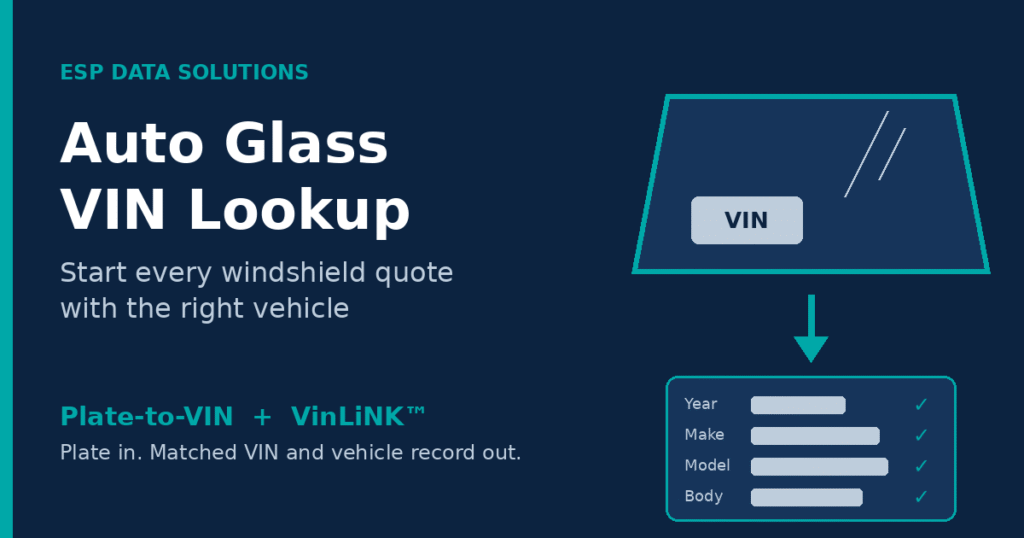
- Start with a license plate. The customer or claim gives a plate and registration state. Plate-to-VIN returns the matching VIN when one is available, so nobody has to read the VIN through cracked glass.
- Decode the VIN. VinLiNK™ can return structured vehicle details such as year, make, model, trim, body style and number of doors in JSON or XML. Available fields depend on the vehicle and report tier.
- Map to industry standards. VinLiNK™ reports include ACES mapping, which gives a connected glass catalog a standardized vehicle reference based on the Auto Care Association’s vehicle configuration database. ACES does not identify the correct windshield by itself; the catalog applies its own fitment data.
- Confirm and continue. The confirmed vehicle record passes to the shop’s glass catalog, calibration lookup and pricing tools.
A Practical Auto Glass Quoting Workflow
A reliable windshield quote usually moves through these steps:
- Plate match: the customer’s plate and state return the matching VIN.
- VIN decode: VinLiNK™ returns year, make, model, trim, body style and ACES mapping.
- Customer confirmation: the customer confirms the year, make, model and body configuration.
- Catalog lookup: the glass catalog returns candidate glass parts for that vehicle.
- Feature check: the technician verifies sensors, heads-up display, heating and other glass-specific features.
- Calibration check: OEM procedures determine whether calibration is required.
- Manual review: any configuration that remains unresolved goes to a person before the part is ordered.
In ESP testing, the plate-matching step typically completed in about two seconds. When no VIN is on record for a plate, the API returns a clear no-match response, and the workflow can fall back to VIN entry or a year/make/model selector powered by ESP Year Make Model Tables.
What ESP Provides — and What Your Glass Tools Provide
A clear division of roles keeps every quote accurate:
- ESP Plate-to-VIN: converts a plate and registration state into the matching VIN when one is available. It returns vehicle data only, with no owner name, address or other personal information.
- ESP VinLiNK™: decodes the VIN into vehicle specifications with ACES mapping, for model year 1981 and newer.
- Your glass catalog: performs the glass part-number lookup and identifies candidate parts and relevant features such as rain sensors, heads-up display compatibility or heated areas.
- OEM repair information and calibration resources: confirm replacement procedures and determine whether calibration is required.
- Your shop or platform: schedules the job, prices it and manages the insurance or customer billing.
In short, ESP helps the glass lookup start with a matched VIN and decoded vehicle record.
Who Can Use Auto Glass VIN Lookup
- Auto glass shops and mobile installers quoting jobs by phone or online
- Auto glass software providers building quoting, scheduling and billing platforms
- Insurance glass claim programs and third-party administrators verifying vehicles on incoming claims
- Fleet managers handling glass replacement across many vehicles
- ADAS calibration centers confirming vehicle details before calibration work
Auto Glass VIN Lookup for Software Platforms and Busy Shops
Plate-to-VIN and VinLiNK™ connect through standard APIs, so a software provider can add vehicle identification to an existing product without changing its glass catalog or pricing engine. VinLiNK™ is pay-as-you-go with no contracts or annual license fees, and vehicle data updates weekly. For fleet lists or claim backlogs, batch VIN decoding processes up to 250,000 VINs per request.
Frequently Asked Questions
Can a windshield quote start with just a license plate?
Yes. The customer provides the plate and registration state, Plate-to-VIN returns the matching VIN, and VinLiNK™ decodes the vehicle details so the quote can move forward.
What vehicle details does VinLiNK™ return for auto glass work?
VinLiNK™ returns year, make, model, trim, body style, number of doors and other build details, plus ACES mapping. The exact fields depend on the vehicle and the report tier you choose.
How does ESP data work with glass part catalogs?
ESP identifies the vehicle; your glass catalog identifies the part. A confirmed VIN and body configuration give the catalog lookup a more reliable starting point.
Does ESP data help with ADAS calibration?
ESP gives you the confirmed vehicle record needed to begin a calibration check. Calibration requirements themselves come from OEM repair information and calibration resources.
Can auto glass software companies integrate ESP into their platforms?
Yes. The APIs are designed for integration, so a software provider can offer plate and VIN lookup to every shop on its platform. Account setup and usage terms are arranged directly with ESP.
Start Your Auto Glass VIN Lookup with ESP
An auto glass VIN lookup can give each quote, claim and calibration check a more reliable vehicle starting record. Contact ESP Data Solutions to set up a free testing account and try Plate-to-VIN and VinLiNK™ with your own plates and VINs before you go live.
Product details, pricing terms and testing-account availability last verified November 2026.