Each year, Massachusetts cities and towns issue motor vehicle excise bills for vehicles subject to the tax, relying on accurate registration and vehicle information. An excise tax VIN lookup helps billing software vendors, deputy collectors, and assessors confirm the year, make, model, and manufacturer’s suggested retail price (MSRP) behind each record, quickly and at scale.
Quick Answer
- Massachusetts excise is based on list price, not market value. By law, the value is a percentage of the manufacturer’s list price and the vehicle’s age, taxed at $25 per $1,000 of valuation.
- VinLiNK™ decodes a VIN into standardized vehicle data, and its Basic Plus report adds MSRP for $0.25 per report.
- Batch jobs of up to 250,000 VINs, according to ESP Data Solutions, let vendors and collectors review whole excise files at once.
How Motor Vehicle Excise Valuation Works
Under Massachusetts General Laws Chapter 60A, the excise is levied by the city or town where the vehicle is garaged. According to the Secretary of the Commonwealth, assessors can levy excises based only on the manufacturer’s list price and the age of the vehicle, not on present market value, price paid, or condition.
The state’s valuation schedule, as published on Mass.gov, works like this:
- Year preceding the designated year of manufacture (model year): 50% of list price
- Designated year of manufacture (model year): 90%
- Second year: 60%
- Third year: 40%
- Fourth year: 25%
- Fifth year and onward: 10%
These percentages are applied according to the vehicle’s model year and the applicable excise year, not its current market value.
The Registry of Motor Vehicles prepares excise data from registration records and sends it to city and town assessors, who then prepare the bills. As a result, many communities rely on software vendors and collection services to process, review, and correct that data.
Where Excise Tax VIN Lookup Fits
1. Confirming Vehicle Details Behind a Bill
When a taxpayer questions a bill, the first step is often confirming what the vehicle actually is. Decoding the VIN returns standardized year, make, model, and trim data where available, so staff can quickly see whether the record matches the vehicle.
2. Supporting MSRP Reviews
The VinLiNK™ Basic Plus report provides manufacturer MSRP data that can serve as an additional reference when reviewing vehicle records. Massachusetts motor vehicle excise valuations are determined under state law using official valuation data, not independently calculated from VinLiNK™ MSRP.
3. Reviewing Entire Excise Files
Excise commitments can include thousands of records at once. With bulk VIN decoding, you submit a file and retrieve decoded results once processing is complete. In addition, batch validation helps flag VINs that fail supported validation checks before decoding, allowing staff to review questionable records.
4. Starting From a License Plate
Taxpayers often call with a plate number rather than a VIN. Plate-to-VIN can return the matching VIN for a U.S. plate and state, with no owner information, which VinLiNK™ can then decode. A lookup may return no match, so staff should confirm the vehicle identity and keep a VIN-entry fallback.
5. Serving Other States and Localities
Other states and local governments tax vehicles in different ways, and some use different valuation sources. Wherever a process needs consistent year, make, model, and MSRP data, the same VinLiNK™ workflow can support it.
Example: Reviewing an Excise Record With VIN Data
Here’s how responsibilities typically divide when staff review a single excise record:
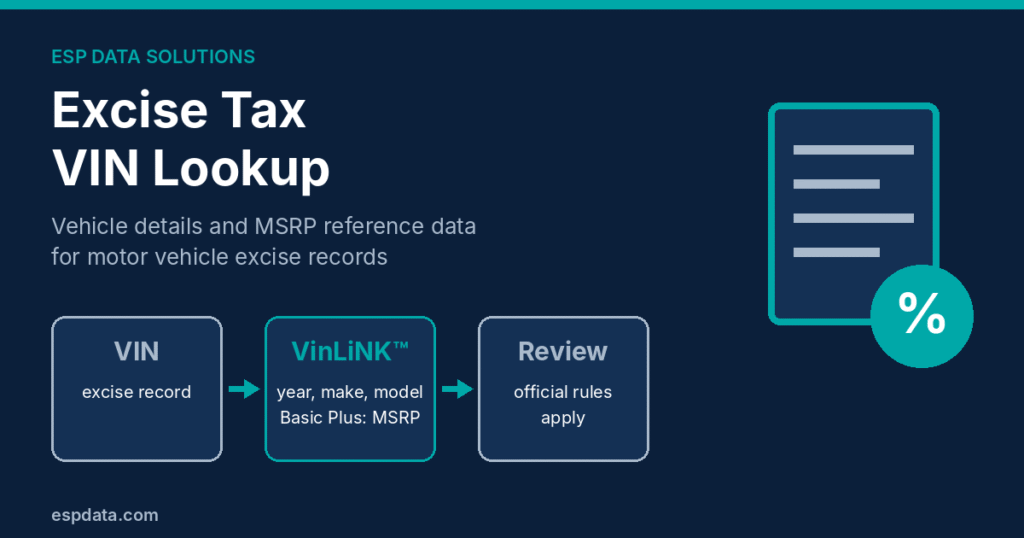
- VIN: comes from the RMV or municipal record.
- Year, make, and model: VinLiNK™ decoding.
- Manufacturer MSRP: VinLiNK™ Basic Plus, as reference data.
- Official excise valuation: Massachusetts official records.
- Tax amount: the applicable state law and valuation schedule.
- Abatement decision: municipal assessors.
What an Excise Tax VIN Lookup Provides and What Comes From Official Sources
- Year, make, model, trim, and engine: VinLiNK™ provides standardized data where available. Field availability varies by vehicle, model year, source data, and report tier.
- MSRP (Basic Plus): VinLiNK™ provides it as reference data. The official excise valuation comes from the state’s rules and RMV data.
- Registration, garaging location, and ownership: These come from RMV and municipal records.
- Abatements and exemptions: Assessors decide them under state law.
Which VinLiNK™ Report Fits an Excise Tax VIN Lookup?
For most excise workflows, the choice comes down to two reports:
- Basic ($0.20 per report): Year, make, model, and trim data, NHTSA-required manufacturer data, and ACES mapping. Helps confirm vehicle identity.
- Basic Plus ($0.25 per report): Everything in Basic, plus MSRP, dimensions and weight, and manufacturer warranty. The best fit when MSRP reference data is needed.
The Enhanced ($0.50) and Recall ($0.25) reports serve other workflows, such as detailed equipment data or recall checks, and aren’t typically needed for excise reviews.
Prices are taken from the VinLiNK™ pricing page as of November 2026, and prices and terms may change. Accounts work on prepaid funds with a $100 minimum deposit, and funds need to be used within a year. If your data must stay inside your own network, VinPOWER is ESP’s separate on-premises decoder for .NET and Java environments.
Frequently Asked Questions
Does an excise tax VIN lookup include MSRP?
Yes. The Basic Plus report includes manufacturer MSRP for $0.25 per report. Teams can use it as reference data alongside the state’s official valuation rules and RMV records.
Can we decode a full excise commitment file?
Yes. ESP states that VinLiNK™ can process batch jobs of up to 250,000 VINs. You submit a file and retrieve the decoded results once processing is complete.
Can staff look up a vehicle from a license plate?
Yes. Plate-to-VIN can return the matching VIN for a U.S. plate and state, with no owner information. Match rates vary by state and record availability, so staff should confirm the vehicle before using the result.
Does ESP already work with organizations in this field?
Yes. ESP Data Solutions already supports organizations that work with vehicle excise and tax data, and our team can help you choose the right report for your workflow.
Can we test an excise tax VIN lookup with our own records first?
Yes. ESP Data Solutions offers a free testing account, so you can decode a sample of your own excise records and review the results before you commit.
Make Excise Tax VIN Lookup Part of Your Workflow
An excise tax VIN lookup gives billing vendors, collectors, and assessors fast, consistent vehicle data for every record they review. Request a free VinLiNK™ testing account and test it with a sample of your own excise data, or call ESP Data Solutions at (978) 975-3333. ESP has provided vehicle data for more than 30 years, and VinLiNK™ has decoded more than one billion VINs.
Product details and sources last reviewed: November 2026. This article is general information, not tax or legal advice.