
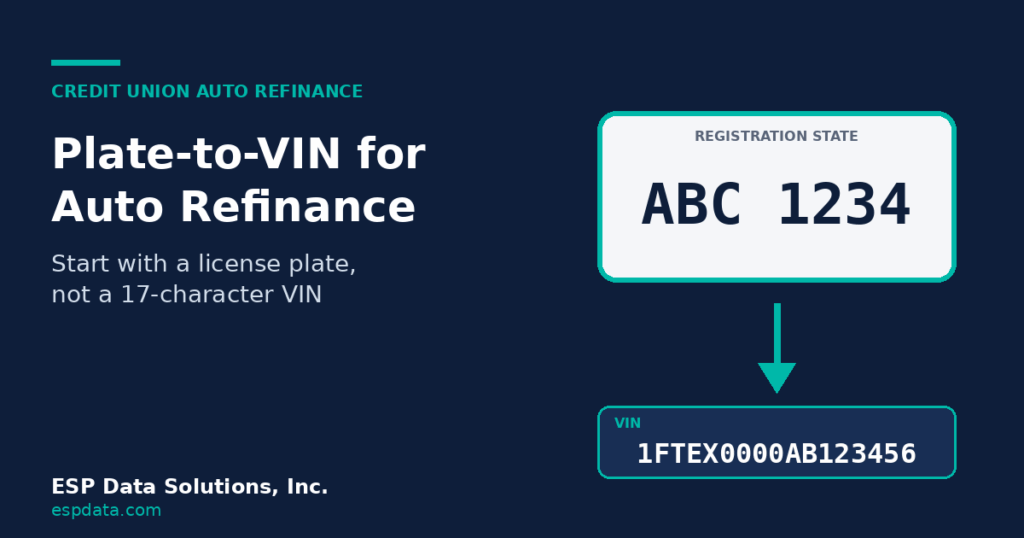
Auto refinance applications often require a 17-character VIN. Plate-to-VIN gives auto refinance applicants another way to identify their vehicle: they enter a license plate number and registration state and, when a match is returned, confirm the correct vehicle before continuing.
Some lenders already use this plate-first pattern. PenFed’s auto refinance page, for example, allows applicants to provide either “your automobile’s VIN OR state of registration and plate number.” Its public page does not identify the underlying data provider. Credit unions can implement a similar workflow with Plate-to-VIN from ESP Data Solutions.
Why Plate-to-VIN Intake Matters for Auto Refinance at Credit Unions
Refinancing gives members a way to lower their monthly payment when rates or their credit profile improve. For credit unions, it is also a way to bring auto loans held at other lenders into the credit union and deepen the member relationship.
In a refinance application, the applicant may need to provide information about a vehicle they already own without assistance from a selling dealer. That makes vehicle identification an important part of the intake workflow. A plate-first option gives applicants another way to supply that information while keeping VIN entry available as a fallback.
The VIN Step in Refinance Applications
With a new purchase, the dealer usually supplies the VIN. With a refinance, the applicant may complete the form independently and needs to provide the vehicle information directly. Lender guidance such as Navy Federal’s refinancing overview lists the 17-character VIN among the details applicants may need to gather.
If the VIN isn’t at hand, the applicant may need to:
- Find it on the vehicle, typically on the dashboard near the windshield or on the driver-side door jamb label
- Look it up in documents, such as a registration card or insurance card
- Type 17 characters carefully, where some letters and numbers look alike
A license plate and state give the applicant another way to start, which is the idea behind plate-based vehicle identification. As a result, the form is designed to ask for less manual entry at the very first step.
How Plate-to-VIN for Auto Refinance Works
Here is a simple intake workflow:
- The applicant enters a plate and state on your online refinance application.
- Plate-to-VIN returns the matching VIN or VINs. Results can also include year, make, model, trim, and other attributes available for the selected report tier and source record.
- The applicant confirms the vehicle on screen, for example, “Is this your 2021 Honda CR-V EX?”
- Your system prefills the application with the applicant-confirmed VIN and vehicle details.
- Your lending team continues with valuation, title, and lien verification as usual.
Plate-to-VIN supports lookups across all 50 U.S. states. It is a vehicle data service: it returns matching VINs and vehicle reports, not the owner’s name, address, or other personal information.
Choosing a Plate-to-VIN Workflow for Auto Refinance
The VinLink documentation describes three practical options:
- Raw plate lookup (
/report/v1/plate/vins): Use it when you only need the associated VIN. It returns one or more matching VINs. - Plate + Basic report (
/report/v1/report/plate_basic): Use it when you need core vehicle identification. It returns the VIN plus a Basic vehicle report in the same request. - Plate + Basic Plus report (
/report/v1/report/plate_basic_plus): Use it when underwriting needs a richer record. It returns the VIN, Basic data, and MSRP data, weights and dimensions, and warranty information where available.
Field availability depends on the vehicle, the source record, and the report tier. Plate-plus-report workflows may also involve separate plate lookup and vehicle report charges, so confirm report permissions and billing with ESP before production deployment. Before going live, test representative plates from the states and vehicle segments your credit union serves, including no-match and multiple-match scenarios.
Implementation Tips: Plate-to-VIN on Your Auto Refinance Form
A well-designed plate lookup step handles every outcome smoothly:
- Validate the input: Require both the plate number and registration state, follow the API input requirements, and show a clear correction message for missing or invalid values.
- Ask the applicant to confirm: Show the decoded year, make, model, and trim, and let the applicant confirm or reject the match.
- Handle multiple matches: When a plate returns more than one VIN, Plate-to-VIN returns all of them, so your form can let the applicant choose the right vehicle.
- Handle no-match results: When no match is available, the API returns a no-match response instead of a guess. Your form can then show a manual VIN field.
- Keep a manual fallback: Match availability can vary by plate, registration state, and available source records, so a manual VIN option should always remain available.
- Keep credentials server-side: Route plate lookup requests through your backend rather than exposing API keys in a browser or mobile app. ESP’s API key guide recommends storing keys in a secure secret manager, using one key per application or environment, and restricting keys to the report types the integration needs.
- Collect the remaining details separately: Mileage, ownership, title and lien status, and condition still come from the applicant and your standard verification process.
What to Measure After Launch
A simple measurement plan helps your team see how the plate-first step performs with your own applicants:
- Plate lookup match rate, plus the share of multiple-match and no-match results
- Manual VIN fallback rate, meaning how often applicants switch to typing the VIN
- Applicant confirmation rate, meaning how often applicants accept the suggested vehicle
- Median response time for the lookup step in your environment
- Application completion rate, compared before and after launch
- VIN corrections your lending team still needs to make
Add Deeper Vehicle Data With VinLiNK™
Once you have the VIN, VinLiNK™ can add the detail your underwriters need, from Basic Plus specifications to the Recall Report, which lists manufacturer recalls for the vehicle. Together, plate-first refinance intake and VinLiNK™ help your team start each refinance file with structured vehicle data rather than free-text entry. For more on how vehicle data supports underwriting, see our article on auto loan collateral verification, based on conversations with credit union lenders at APEX 2026.
What Plate-to-VIN Supports and What Your Process Still Handles
- Plate-to-VIN supports: Vehicle identification, application prefill, and fewer manually typed VINs
- VinLiNK™ adds: Deeper specifications and recall data
- Your existing process still handles: Ownership, title and lien status, mileage, condition, and current market value
Frequently Asked Questions
Can applicants start a refinance application without their VIN?
Yes. An applicant can enter a license plate number and registration state, and the application can retrieve one or more associated VINs and, with a composite report, available vehicle details. A manual VIN field remains available when no match is returned.
Does Plate-to-VIN work in every state?
Yes. Plate-to-VIN supports lookups across all 50 U.S. states. Match availability can vary by plate and registration state.
What information does Plate-to-VIN return?
Plate-to-VIN returns vehicle data: the matching VIN or VINs and, with a composite report, vehicle attributes such as year, make, model, and trim where available. It does not return owner names, addresses, or other personal information.
What happens if a plate returns multiple VINs or no match?
If multiple VINs are found, the form can ask the applicant to select or confirm the correct vehicle. If no VIN is available, the API returns a no-match response, and the form can display a manual VIN field.
What does Plate-to-VIN cover in the auto refinance process?
Plate-to-VIN supports vehicle identification by using a license plate and registration state to locate one or more associated VINs and, with a composite report, vehicle details. It may also return no match when an associated record is unavailable. Ownership, title, lien status, mileage, condition, and current market value continue to come from your credit union’s existing data sources and verification process.
Can Plate-to-VIN connect to our loan origination system?
Yes. Plate-to-VIN is an API, so credit unions and their technology partners can connect it to online applications, LOS platforms, and member-facing apps. The integration effort depends on your systems, so it’s best to review it with your LOS provider or IT team.
Can the same lookup help with other loan types?
Yes, potentially. Any member-facing form that asks for vehicle details, such as a direct auto loan application, could use the same plate-to-VIN step. Contact us to discuss your specific workflow.
Start Using Plate-to-VIN for Auto Refinance Applications
A plate-first intake step gives applicants another way to identify their vehicle, while your lending team receives an applicant-confirmed vehicle match and structured vehicle data. A plate-first refinance workflow, paired with VinLiNK™, is designed to simplify vehicle identification for applicants and lending teams.
Contact ESP Data Solutions to test Plate-to-VIN with representative refinance application scenarios and compare the raw, Basic, and Basic Plus workflows.
Last reviewed: October 2026.