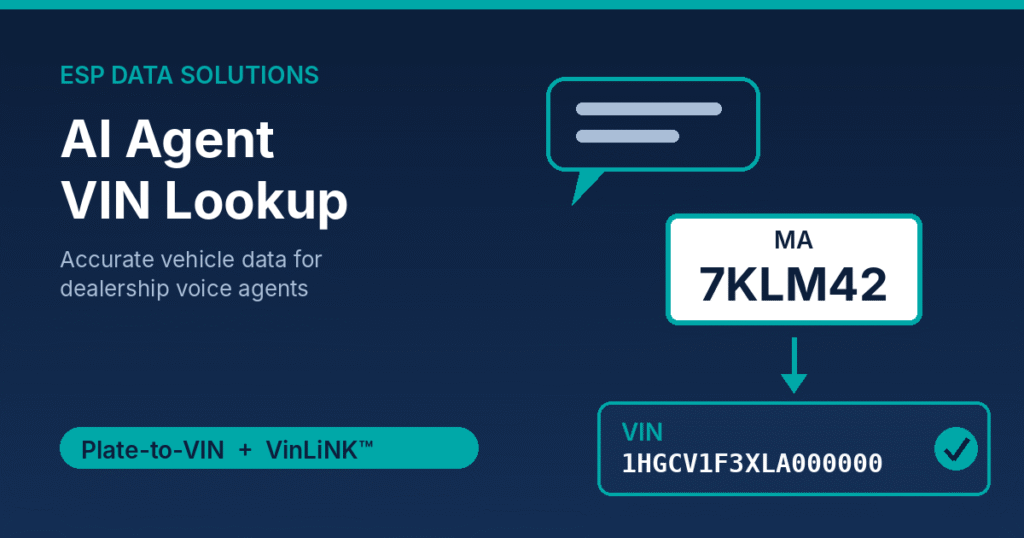
AI agent VIN lookup is a workflow that lets a voice agent or chatbot identify a caller’s vehicle from a U.S. license plate and registration state. Plate-to-VIN finds the matching VIN when a record is available, and VinLiNK™ turns that VIN into structured vehicle data the agent can confirm with the caller.
This guide is written for the teams that build and deploy dealership AI agents, from AI platform developers to dealer groups rolling out voice agents in service, sales, and parts.
Why AI Agents Need a Reliable Vehicle Data Source
Language models are excellent at conversation. However, they are not a source of vehicle facts. When a caller says “I have a 2019 Silverado,” the agent still doesn’t know the engine, drivetrain, or trim.
Those details matter downstream. They help the parts catalog narrow down the right fitment, and they help the service team plan the visit. When the agent relies on an unverified description instead, inaccurate vehicle details can enter the appointment record and affect downstream work. That is why reliable dealership AI deployments connect the agent to a dedicated vehicle data API rather than to free-text descriptions.
How AI Agent VIN Lookup Works
Callers often don’t have their 17-character VIN at hand during a conversation, but they may be able to provide a license plate number and registration state. ESP Data Solutions pairs two products into one simple flow:
- The caller shares a plate and state. The agent asks a natural question, such as “What’s your license plate number and state?”
- Plate-to-VIN finds the VIN. It covers all 50 states and returns the matching VIN when a record is available.
- VinLiNK™ decodes the VIN. The agent receives structured year, make, model, trim, engine, and other specifications in JSON or XML.
- The agent confirms with the caller. For example: “I see a 2019 Chevrolet Silverado 1500 with the 5.3L V8. Is that right?”
- Your integration passes the data on. The confirmed vehicle details can be mapped into DMS, CRM, or scheduling fields.
When a plate doesn’t return a match, the agent asks for the VIN. If the caller can’t provide it, the platform routes the call to its existing manual identification process.
Designing the AI Agent VIN Lookup Conversation
The data is only half of the job. How the agent requests and confirms the information can influence whether callers trust the result. Here is a short example of a well-designed exchange:
Agent: “To pull up your vehicle, could you tell me your license plate number and state?”
Caller: “It’s 7-K-L-M-4-2, Massachusetts.”
Agent: “Thanks. That’s 7, K, L, M, 4, 2 in Massachusetts, correct?”
Caller: “Yes.”
Agent: “I have a 2021 Toyota RAV4 XLE with the 2.5-liter engine. Is that your vehicle?”
A few rules make this work reliably:
- Read the plate back before the lookup: Voice recognition can mix up similar letters and numbers, such as B and D or 8 and A, so a quick read-back catches errors early.
- Confirm the vehicle before saving it: The caller verifies the decoded details before anything is written to your DMS or CRM.
- Accept a correction gracefully: If the caller says “That’s not my car,” the agent asks again or requests the VIN instead.
- Hand off when needed: Set a retry limit that suits your platform. For example, after two unsuccessful attempts, transfer the caller to a service advisor.
- Plan for temporary errors: If a lookup times out or fails, the agent can retry once or ask for the VIN, giving the caller a clear path forward when the lookup is temporarily unavailable.
Before launch, test the flow with plates from several states, an unknown plate, a mistyped plate, a caller who corrects the vehicle, and a caller who reads the VIN aloud.
Who Does What in an AI Agent VIN Lookup Workflow
A clear division of roles keeps every AI deployment reliable:
- ESP Data Solutions identifies the vehicle: Plate-to-VIN and VinLiNK™ supply the VIN and the decoded vehicle record.
- The AI platform runs the conversation: It asks the questions, confirms the vehicle with the caller, and decides what happens next.
- Your DMS or scheduler handles the booking: It manages appointment slots, parts lookups, labor times, and customer records.
In this workflow, ESP handles vehicle identification and structured vehicle data, so it fits alongside whichever AI platform and DMS a dealership already uses.
Benefits of AI Agent VIN Lookup for Dealerships
When the data is integrated well, AI agent VIN lookup can help:
- Speed up intake: The agent can reduce the vehicle information callers must spell out and staff must type in manually.
- Reduce guesswork in the service lane: Engine and trim data gives parts and service teams a stronger starting point than a caller’s description.
- Surface recall information: The VinLiNK™ Recall Report can flag manufacturer recall and safety campaigns for follow-up, so the agent can let your service team know while the caller is on the line. Your team then confirms the VIN-specific open or unrepaired status with the manufacturer before scheduling recall service. Learn more in our guide to dealer recall checks.
- Support sales and trade-in calls: The same plate lookup also powers trade-in license plate lookup on dealer websites.
- Build caller trust: Callers get the chance to verify their vehicle before the appointment is recorded.
Built for AI Platform Developers
If you build AI agents for automotive businesses, ESP Data Solutions can be the vehicle data layer behind your product. We have supplied VIN decoding since 1994.
- Broad coverage: VinLiNK™ covers model years 1981 onward across passenger cars, light and heavy trucks, motorcycles, buses, trailers, and RVs. Available fields vary by vehicle and report tier.
- Developer-friendly output: Structured JSON or XML that your agent can read and act on immediately.
- Clean data before launch: With VIN batch decoding, you can enrich up to 250,000 existing customer VINs per request, so your agent starts with enriched, structured vehicle records instead of VIN-only files.
- Vehicle-focused results: Plate-to-VIN returns vehicle data without owner names, addresses, or other personal information, which makes it a comfortable fit for automated conversations. Your AI platform continues to manage caller inputs, transcripts, and customer records under its own privacy and security policies.
- Secure API access: Keep API credentials on your backend server, never inside the voice agent prompt or a browser chat widget, and rotate them on your usual security schedule.
Product details and service information are available on the VinLiNK™ service page. Want to see how VinLiNK™ compares with free decoding tools? Read our VIN decoder API comparison.
AI Agent VIN Lookup Metrics to Track After Launch
A few simple metrics show how well the vehicle lookup is working inside your AI conversations:
- Plate match rate: The share of plate lookups that return a VIN.
- VIN fallback rate: How often the agent has to ask for the VIN instead.
- Caller confirmation rate: How often callers confirm the decoded vehicle on the first try.
- Correction rate: How often callers say the vehicle is wrong.
- Response time: How long the plate lookup takes on its own, and how long the full plate-to-confirmation step takes during a live call.
- Transfer rate: How often the call moves to a service advisor during vehicle identification.
Tracking these numbers helps your team tune prompts, retry limits, and fallback paths over time.
Frequently Asked Questions
Can an AI voice agent identify a vehicle from a license plate?
Yes. By connecting to Plate-to-VIN, an AI agent can convert a plate and state into a VIN, then decode it with VinLiNK™. Plate-to-VIN covers all 50 states, although a match isn’t guaranteed for every plate.
What happens when a plate doesn’t return a match?
The agent asks the caller for the VIN, sends it straight to VinLiNK™, and confirms the decoded vehicle as usual. If the caller doesn’t have the VIN either, the platform can transfer the call to a service advisor.
What if the caller knows their VIN?
Even better. The agent sends the VIN straight to VinLiNK™ and skips the plate step entirely.
What vehicle details can the agent use?
VinLiNK™ returns structured specifications such as year, make, model, trim, and engine. Report tiers range from Basic to Enhanced, plus a Recall Report for manufacturer recall and safety campaign data. Available fields vary by vehicle and report tier.
Does Plate-to-VIN share owner information?
Plate-to-VIN is built for vehicle data only. It returns the vehicle’s VIN and no owner or personal details, which keeps your AI conversations focused and privacy-friendly.
Which AI platforms can connect to ESP Data Solutions?
Any AI agent, chatbot, or voice platform that can call a web API can be integrated. Your developers add authentication, response handling, and field mapping, and results arrive as JSON or XML ready to map into DMS or CRM fields.
Give Your AI Agent the Right Data
AI is changing how dealerships answer the phone, and accurate vehicle identification is an important part of a reliable service-intake workflow. With AI agent VIN lookup from ESP Data Solutions, your voice agent or chatbot can identify and confirm the caller’s vehicle without relying on free-text descriptions. Contact our team to request a demo of Plate-to-VIN and VinLiNK™ and start building smarter AI conversations today.