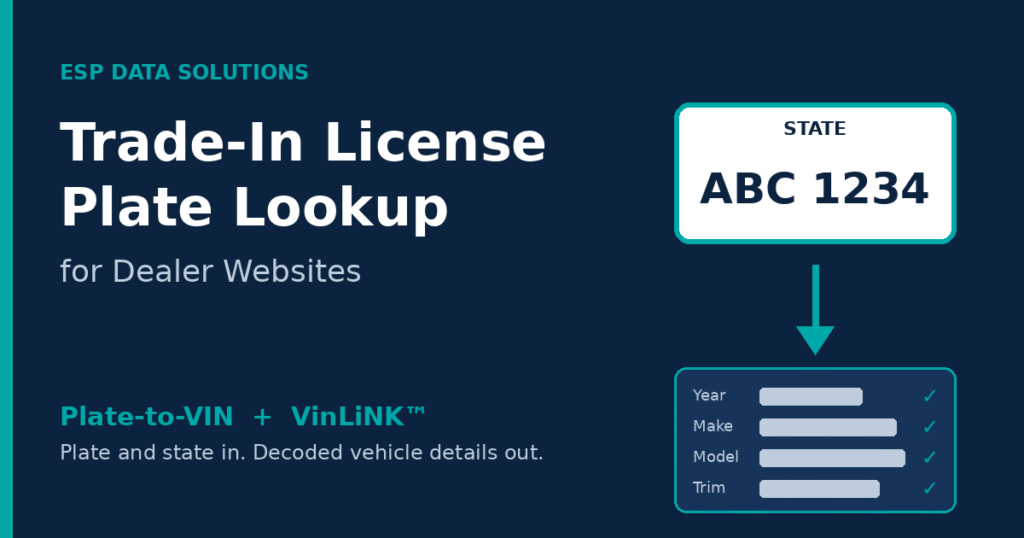
A trade-in license plate lookup lets shoppers identify their vehicle with a plate number and registration state instead of typing a 17-character VIN. When a match is available, the form can prefill decoded vehicle details without requiring the shopper to enter a VIN first.
That first step matters. A shopper who values a vehicle on your website is signaling interest in a trade-in or vehicle sale, and requiring extra vehicle information at the first step adds effort before they reach an offer. ESP Data Solutions has supplied vehicle data to the automotive industry for more than 30 years. Here is how our Plate-to-VIN and VinLiNK™ APIs fit inside a trade-in or instant-offer tool.
Why the First Field of a Trade-In Form Matters
A license plate number is often easier to access or enter than a 17-character VIN. The VIN is printed on the windshield label, the door jamb or the registration card, so finding it often means a trip to the car or a search through paperwork. That is friction at exactly the moment you want momentum.
Year/make/model dropdowns are quicker, but they can introduce a different problem. A shopper may choose the wrong trim or engine, and an offer built on the wrong configuration may change at the in-store appraisal.
Plate-first experiences are already appearing on dealer websites. For example, Cars Commerce reported a 50% increase in trade-in leads during its May–June 2024 pilot after introducing a single-page, plate-or-VIN prefill experience in its AccuTrade tool. That result applies to AccuTrade, not to ESP, but it provides one third-party example of how reducing initial vehicle-entry work may affect trade-in form performance.
How Trade-In License Plate Lookup Works
Using a composite Plate + Vehicle Report endpoint, the lookup and decode can run in a single API request behind your existing form. In ESP testing, the plate-matching step typically completed in about two seconds, although total response time depends on network and integration conditions:
- The shopper enters plate and state. No VIN hunt and no long dropdown list.
- Plate-to-VIN returns one or more matching VINs found in the available source records. Lookups are supported across all 50 states, and if multiple matches are returned, the form can ask the shopper to confirm the correct vehicle.
- VinLiNK™ decodes the VIN. Available build details, such as year, make, model, trim, engine and body style, prefill the form.
- The shopper confirms the vehicle and adds mileage, condition and photos.
- Your valuation engine prices it, and the lead reaches your CRM with a decoded vehicle record attached.
When no VIN is on record for a plate, the API returns a clear no-match response rather than a partial guess. Your form can then switch to VIN entry or a year/make/model selector powered by ESP Year Make Model Tables, giving the shopper an alternative path.
Plate, VIN or Year/Make/Model: Choosing the Entry Path
A practical trade-in workflow can offer all three entry paths. The order below is a useful starting point, but dealers should test it against their own completion data:
- License plate and state (first option): short input that can prefill decoded details in one step when a match is available.
- VIN entry (second option): a unique vehicle identifier for shoppers who have it handy, decoded directly by VinLiNK™. Some trim or equipment details may still need the shopper’s confirmation.
- Year/make/model selector (fallback): a widely available option that still depends on the shopper choosing the correct configuration.
Whichever path the shopper uses, ask them to confirm the selected or decoded year, make, model and trim before entering mileage and condition.
What ESP Provides — and What Your Platform Provides
A clear division of roles keeps expectations accurate:
- ESP Plate-to-VIN: the Plate-to-VIN license plate lookup API converts a plate and registration state into one or more matching VINs found in the available source records. It returns vehicle data only, with no owner name, address or other personal information.
- ESP VinLiNK™: decodes the VIN into structured vehicle specifications in JSON or XML, for model year 1981 and newer, covering cars, trucks, motorcycles, RVs, buses and trailers. Available fields depend on the vehicle and the report tier you choose.
- Your form, CRM and valuation provider: collect mileage, condition and photos, run history checks, calculate the offer and manage the lead.
In short, ESP identifies the vehicle so that your appraisal process starts from a shopper-confirmed vehicle record. Credit unions can use a similar plate-first workflow for loan applications, as described in our guide to Plate-to-VIN for auto refinance applications.
What Dealers and Trade-In Platforms Can Gain
- Less form friction. Replacing VIN entry with a plate field can help more shoppers move from the first question to the offer.
- More specific vehicle data. Available trim and engine details give the valuation system a more detailed starting record than a free-text vehicle description.
- More structured lead records. Your sales team can receive a decoded VIN and standardized vehicle fields instead of relying only on free-text notes such as “2019 Silverado, good condition.”
- Acquisition opportunities. Each completed trade-in is a potential inventory source, not only a sales lead.
- Vehicle-focused lookups. Plate-to-VIN does not return owner names, addresses or other personal information, so the lookup stays focused on vehicle data.
Who Can Use a Trade-In License Plate Lookup
- Franchise and independent dealers adding “Value Your Trade” to their websites
- Dealer website and digital retailing providers building trade-in widgets for many rooftops
- Instant-offer and “we buy cars” businesses sourcing vehicles directly from consumers
- Wholesalers and auction platforms collecting consignment vehicles online
- CRM and lead-management vendors enriching incoming trade-in leads
Getting Started with ESP Data Solutions
Plate-to-VIN and VinLiNK™ connect through standard APIs, so your developers can add them to an existing trade-in form without replacing their valuation system. VinLiNK™ is pay-as-you-go with no contracts or annual license fees, vehicle data updates weekly, and ESP offers a free testing account so your team can evaluate results before going live. If you also need to decode existing inventory or lead lists, batch VIN decoding processes up to 250,000 VINs per request.
Frequently Asked Questions
Can shoppers start a trade-in with just a license plate?
Yes. The shopper enters the plate and state, Plate-to-VIN returns one or more matching VINs found in the available source records, and VinLiNK™ decodes the available vehicle details to prefill the form.
Which states does Plate-to-VIN cover?
Plate-to-VIN supports lookups across all 50 states. Match availability varies by plate, registration state and available source records, so a VIN or year/make/model fallback provides an alternative path when no plate match is available.
What happens if a plate is linked to more than one VIN?
Plate-to-VIN returns the matching VINs found in the available source records for that plate and state. Your form can then show the matching vehicles so the shopper selects the right one before continuing.
What vehicle details fill in automatically?
VinLiNK™ can return year, make, model, trim, engine, body style and other build specifications. The exact fields depend on the vehicle and the report tier you choose.
How do mileage and condition fit in?
The shopper adds mileage, condition and photos after the vehicle is identified. Your valuation engine then combines those answers with the decoded specifications to generate the offer.
Does Plate-to-VIN return owner information?
Plate-to-VIN is built for vehicle identification. It returns vehicle data only, with no owner names, addresses or other personal information.
Can trade-in platform vendors use it across many dealer sites?
Yes. The APIs are designed for integration, so a platform can use them to power trade-in widgets across the dealerships it serves. Account setup and usage terms are arranged directly with ESP.
Start a Plate-First Trade-In Workflow
A trade-in license plate lookup can simplify the vehicle-identification step without replacing your existing valuation workflow. Contact ESP Data Solutions to set up a free testing account and try Plate-to-VIN and VinLiNK™ with representative plates, vehicle types and no-match scenarios before you go live.
Product details, pricing terms and testing-account availability last verified October 2026.