
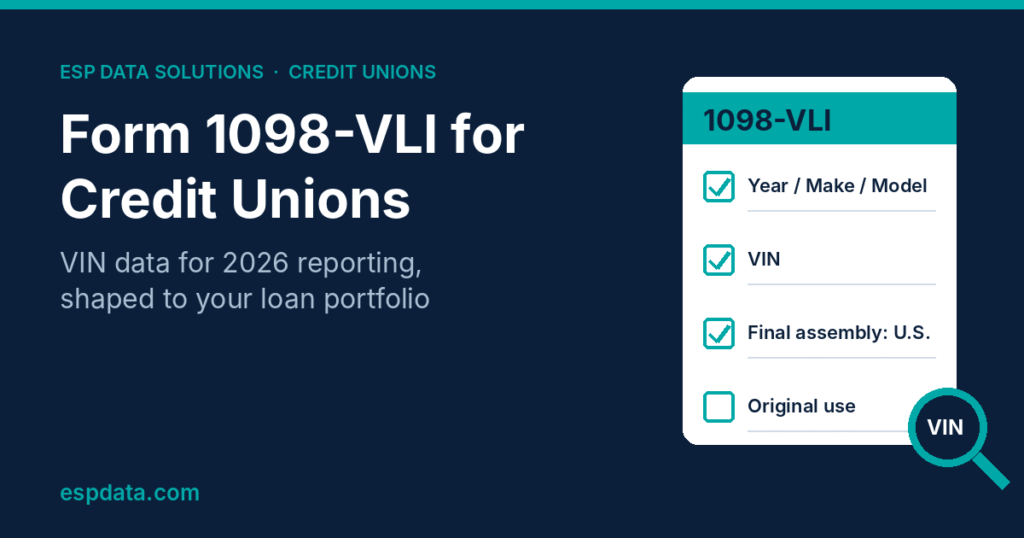
The first full reporting season for the One Big Beautiful Bill Act (OBBBA) car loan interest deduction is here. Credit union 1098-VLI reporting requires details that may be missing from existing loan systems, including where each vehicle was finally assembled.
ESP Data Solutions helps credit unions fill those gaps with VIN data shaped to their portfolio, their file formats and their timeline. Here is what has changed, what you need, and how we can help.
Quick Answer: Credit Union 1098-VLI Reporting
To prepare for Form 1098-VLI, credit unions first identify specified passenger vehicle loans (SPVLs) on which they receive at least $600 of reportable interest in 2026. The $600 threshold applies separately to each loan. An SPVL is generally a loan incurred after 2024 to purchase a qualifying new vehicle for personal use and secured by a first lien on that vehicle. Then, for each reportable loan:
- Confirm vehicle details – year, make, model and VIN
- Check the vehicle requirements – a car, minivan, van, SUV, pickup or motorcycle with a gross vehicle weight rating under 14,000 pounds
- Establish final assembly – whether it occurred in the United States, using the plant of manufacture reported in the VIN
- Confirm original use – whether original use began with the payer of record
- Allocate other amounts – refinancing, negative equity and other nonqualifying amounts may need separate treatment
- Plan for the deadlines – statements to the payer of record in early 2027, then IRS filing
What the Final Rules Mean for Credit Union 1098-VLI Reporting
Treasury and the IRS published the final car loan interest deduction regulations on September 8, 2026, effective November 9, 2026, and did not extend the transition relief that applied to 2025.
The Form 1098-VLI instructions ask for the vehicle’s year, make, model and VIN, and include a checkbox for final assembly in the United States. Helpfully, the instructions allow lenders to rely on the vehicle’s plant of manufacture as reported in the VIN. That makes accurate VIN decoding one of the fastest ways to complete the vehicle side of the form.
For 2026 reporting, January 31 and February 28 fall on Sundays, so statements to the payer of record are due February 1, 2027. Paper returns are due March 1, 2027, while electronically filed returns are due March 31, 2027. Confirm the applicable filing method in IRS Publication 1099.
The Vehicle Data Many Credit Unions Are Missing
America’s Credit Unions has told the IRS that credit unions often lack key eligibility details, such as final assembly location. Common gaps include:
- Assembly location – may be missing from core or loan origination systems
- Vehicle type and weight class – needed to confirm the vehicle is a qualifying passenger vehicle under 14,000 pounds GVWR
- Clean VINs – typos and incomplete entries in older collateral records
- The full back book – every potentially eligible loan originated since January 1, 2025
How ESP Adapts to Your Credit Union 1098-VLI Needs
Every credit union runs a different core, a different team and a different timeline. That is why ESP works with you on a request that fits, rather than a one-size-fits-all product.
- Send the list you already have. Start with a simple file of VINs from your portfolio. Our VIN batch decoding service handles up to 250,000 VINs per request.
- Know where you stand before you pay. The VinLiNK™ batch file workflow validates your VIN list and reports the number of valid and invalid VINs before charges are applied, so you can clean up records first.
- Choose the detail you need. VinLiNK™ report levels range from Basic (year, make, model, trim and NHTSA-required fields) to Enhanced specifications.
- Tell us your file layout. Let us know which fields your core or tax team needs back, and we will discuss the best way to deliver them.
- Keep data in house if required. VinPOWER decodes VINs on your own systems.
- See the result in a simple format. For example, your file lists each loan’s VIN from the collateral record. The decoded result for that VIN returns year, make, model, vehicle type and the manufacturer-reported plant country, which your team can match back to the loan and use for the Box 7 review.
- Add new loans as they close. Real-time VinLiNK™ lookups capture vehicle details at origination, so next year’s reporting starts cleaner.
VinLiNK™ uses prepaid, per-report pricing with no monthly payments, annual license fees or contracts, and you can ask for a free testing account to try it on a sample of your own loans.
What VIN Data Does Not Decide
VIN data supports the vehicle side of reporting. Original use, refinance history, negative equity and the interest calculation come from your loan records. Final assembly is also only one of several requirements, so a vehicle assembled in the United States may qualify, but the full determination depends on all the rules. Work with your tax advisor on eligibility decisions.
For a deeper walkthrough, see our Form 1098-VLI guide for auto lenders and batch VIN decoding for OBBBA portfolio review.
FAQs: Credit Union 1098-VLI Reporting
Can a small credit union without an IT team use ESP?
Yes. You can start with a file of VINs and a conversation with our team about the fields and format you need. ESP helps you choose the simplest path for your size.
Can VIN data help with the final assembly checkbox?
Yes. The IRS instructions allow lenders to rely on the plant of manufacture reported in the VIN, and VIN decoding returns that manufacturer-reported signal for each vehicle.
Can we review our whole back book at once?
Yes. Batch decoding handles up to 250,000 VINs per request, and validation shows how many VINs are valid before any charges apply.
Is there a way to test before committing?
Yes. Ask ESP for a free testing account and run a sample of your own loans first.
Does decoding confirm that a loan qualifies for the deduction?
It confirms the vehicle details the form asks for. Loan-level facts and tax eligibility are determined separately with your records and tax advisor.
Get Ready for Credit Union 1098-VLI Reporting
The first full Form 1098-VLI filing deadlines are approaching, but credit unions can still reduce the manual work required to prepare their vehicle records. Contact ESP Data Solutions to share your portfolio size, core system and timeline, and we will help you plan a credit union 1098-VLI data request that fits.
This article is for general information only and is not tax or legal advice. Confirm reporting requirements with the IRS and your tax advisor.