Whether you run a dealership platform, a credit union loan system, an insurance app or a fleet tool, your vehicle data starts with one decision: which provider turns a 17-character VIN into a structured vehicle record you can trust. When you choose a VIN decoder API, that choice can affect the accuracy of every listing, quote and loan file built on its data.
A sample response only tells part of the story. You also want to test coverage across your real vehicle mix, see how the API handles unclear or invalid VINs, and understand performance, security and total cost. This guide gives you 10 questions to ask any provider, a simple test plan, and how ESP Data Solutions answers each one.
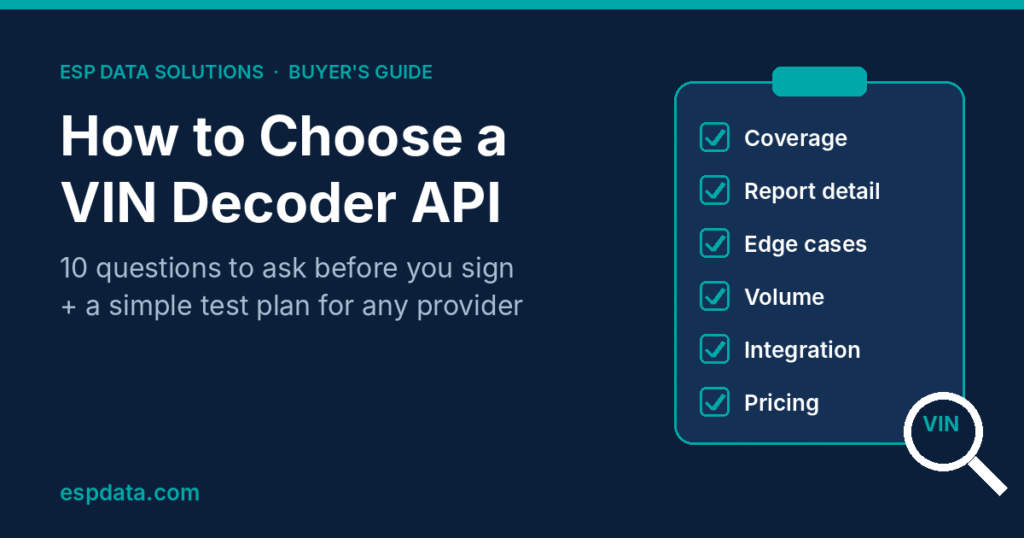
Quick Answer: How to Choose a VIN Decoder API
The right VIN decoder API for your business:
- Covers your vehicles – the model years and vehicle types you actually see
- Returns the detail you need – with report levels you can match to each workflow
- Handles edge cases clearly – invalid, partial or unclear VINs
- Scales with you – fast single lookups plus high-volume batch decoding
- Integrates easily – standard formats, secure access and clear documentation
- Proves itself on your data – a test with your own VIN sample
- Has transparent costs – pricing you can model as volume grows
10 Questions to Help You Choose a VIN Decoder API
1. Which model years and vehicle types are covered?
Coverage gaps turn into manual work. Ask which model years and vehicle types the API supports, and which fields depend on the vehicle’s year and type. Also ask how often the underlying vehicle data is updated and how new model years are added.
How ESP answers: VinLiNK™ decodes vehicles from model year 1981 forward across passenger cars, light trucks and SUVs, heavy trucks, motorcycles, recreational vehicles, buses and trailers. VinLiNK™ data updates are loaded weekly. As with any decoder, the fields available can vary by vehicle type and report level.
2. How much detail does each report include?
Year, make and model are rarely enough. Ask what each report level returns, so you pay only for the detail a workflow needs.
How ESP answers: VinLiNK™ offers four report levels:
- Basic – year, make, model, trim, NHTSA-required fields and ACES mappings
- Basic Plus – everything in Basic, plus dimensions, warranty and MSRP
- Enhanced – everything in Basic, plus technical specifications and optional equipment
- Recall – everything in Basic, plus manufacturer recall and safety campaign data
Each level describes the data the report is designed to return; the fields actually available can vary by vehicle.
3. How does the API handle invalid or unclear VINs?
Typos and incomplete VINs happen every day. Ask how the API signals an invalid VIN, a partial decode or a VIN that could match more than one configuration, so your system can respond correctly.
How ESP answers: VinLiNK™ returns a clear error status for a missing or invalid VIN, so your application can prompt the user to re-enter it. For batch files, validation reports the number of valid and invalid VINs before charges are applied. Because a VIN does not always pin down every trim or option, include unclear cases in your test sample, and ESP’s team is glad to review the results with you.
4. Can it handle your volume?
Most businesses need two speeds: instant lookups at the point of sale and bulk processing for portfolios or inventory audits.
How ESP answers: VinLiNK™ handles real-time single lookups, and ESP’s VIN batch decoding service accepts up to 250,000 VINs per request.
5. How easy and secure is integration?
Ask about response formats, authentication, API versioning and how you can confirm access before going live.
How ESP answers: VinLiNK™ returns JSON, XML or PDF through versioned v1 endpoints. You create scoped, restrictable API keys and exchange them for short-lived JWT tokens, and a test endpoint lets you confirm your token works before making charged requests.
6. Can it start from a license plate?
Customers often know their plate, not their VIN. A provider that offers both saves you a second vendor.
How ESP answers: ESP’s Plate-to-VIN API supports lookups across all 50 states and always returns one VIN per plate, with vehicle data only and no owner or personal information. Matches depend on the plate, the state and available records, so plan a simple VIN-entry fallback. See it in action in trade-in license plate lookup.
7. Do you need cloud, on-premises or both?
Some organizations have security, procurement or data-governance policies that favor local deployment.
How ESP answers: Alongside the VinLiNK™ cloud API, ESP offers VinPOWER, an on-premises VIN decoding library that runs on your own systems.
8. What recall data is included?
Recall information matters for dealers, fleets and lenders. Ask whether a report shows recall campaigns that apply to the vehicle, or the open or completed repair status for that specific VIN, because these are different questions.
How ESP answers: The VinLiNK™ Recall report adds manufacturer recall and safety campaign data to the same decoding workflow. Learn how dealers use it in our dealer recall check guide.
9. How reliable is the service, and who supports you?
An API is a long-term relationship. Ask for uptime and support commitments in writing, and find out who you will talk to when something needs attention.
How ESP answers: ESP Data Solutions has worked with vehicle data for about three decades, and you work directly with a team that knows the product, not an anonymous marketplace listing. Ask ESP for the current availability and support commitments for your plan.
10. What will it really cost?
Ask how each lookup type is priced (single decode, report level, plate match and batch) and how costs change as volume grows.
How ESP answers: VinLiNK™ uses simple prepaid, per-report pricing, published openly on the VinLink pricing page. Volume discounts are available for higher volumes, so contact our team for a quote that fits.
Test Before You Choose a VIN Decoder API
Before you sign, run a side-by-side test with a sample of your own VINs. A good sample includes:
- Older vehicles – to confirm coverage beyond recent model years
- Trucks, motorcycles and trailers – if they appear in your business
- Invalid and mistyped VINs – to see how errors are reported
- Unclear cases – VINs that may match more than one trim or configuration
- Your busiest workflow – single lookups and a batch file at realistic volume
Then score each provider on measurable results:
- Field coverage – the share of VINs that returned every field your workflow requires
- Unclear results – how many VINs came back without a single clear trim or configuration
- Error handling – whether invalid VINs were flagged clearly and consistently
- Speed – median and 95th-percentile response times for single lookups, plus batch processing time at realistic volume
- Cost at full volume – decoding, report levels and plate lookups priced as separate lines
- Developer experience – documentation, versioning, usage limits and how fast support answers
ESP is happy to support this kind of evaluation with VinLiNK™ and Plate-to-VIN.
FAQs: How to Choose a VIN Decoder API
Can one provider handle both VIN and license plate lookups?
Yes. ESP offers both: Plate-to-VIN finds the vehicle from a plate and state, and VinLiNK™ decodes the VIN into a structured vehicle record. One provider means one commercial relationship, one point of contact and a more streamlined integration.
Should a smaller business choose a VIN decoder API?
Yes. Real-time single lookups work just as well for a small credit union or independent dealer as for a national platform. VinLiNK™ uses prepaid, per-report pricing with no monthly payments, annual license fees or contracts. Funds are added in amounts of at least $100, and you can ask ESP for a free testing account to try it on your own VINs first.
Can I decode VINs without using the cloud?
Yes. VinPOWER runs on your own systems, which suits organizations with strict data or security policies.
What does a VIN decoder API tell me about a vehicle?
A VIN decoder API returns vehicle attributes encoded in or associated with the VIN: year, make and model and, depending on the report and vehicle, trim, specifications, equipment and recall campaigns. For title, brand, odometer, total-loss and salvage records, businesses add an NMVTIS vehicle history report, and repair history comes from private history providers.
Should I compare free and commercial options before I choose a VIN decoder API?
Yes, it is a smart first step. Our VIN decoder API comparison explains when a free decoder is enough and when a commercial API pays off.
Ready to Choose a VIN Decoder API?
The best way to choose a VIN decoder API is to put it to the test with your own VIN sample. Explore the VinLiNK™ report levels and Plate-to-VIN, compare the results, and talk directly with the ESP team about coverage, integration and pricing for your volume.