
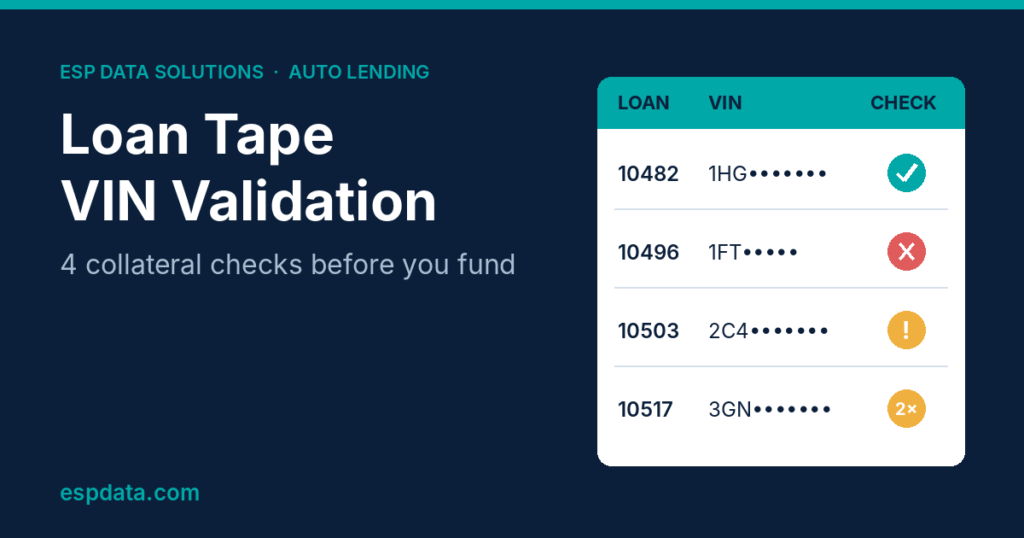
Recent double-pledging allegations in subprime auto lending renewed attention to loan-level collateral controls. Loan tape VIN validation checks every submitted vehicle identification number (VIN) in an auto loan file, decodes valid identifiers, compares the results with the tape and identifies duplicates across the files available to a funder. It cannot, by itself, establish lien priority, prove that a vehicle exists or determine whether another lender has financed the same loan.
An auto loan tape is a loan-level file, often a spreadsheet or delimited data file, containing fields such as loan ID, balance, origination date, payment status and collateral VIN.
Used for what it does well, it is a practical first step for improving collateral data quality before funding. This guide covers four checks, what each one flags, what it does not prove, and how ESP Data Solutions helps you run them on large files.
Quick Answer: What Loan Tape VIN Validation Checks
Loan tape VIN validation helps you:
- Catch invalid VINs – mistyped, incomplete or structurally invalid identifiers
- Compare the vehicle with the tape – decoded year, make and model against the recorded fields
- Spot duplicate VINs – the same VIN appearing on more than one record in the files available to you
- Review collateral against program rules – vehicle types or model years that fall outside the program
It is one part of a broader collateral control process that also includes lien, title and custodian checks.
Why Collateral Data Is Getting More Scrutiny
In August 2026, the SEC charged three former executives of a subprime auto lender for their alleged roles in a multi-year fraud scheme involving the double pledging of subprime auto loans. According to the SEC’s complaint, more than $945 million in principal associated with the ABS offerings remained outstanding and payable to investors when the lender filed for bankruptcy.
The case prompted calls for stronger controls, including asset-level reconciliation of data tapes, VIN by VIN, and checks across every facility. Long-standing guidance points the same way. For national banks and federal savings associations, the OCC’s loan-purchase guidance calls for independent pre-purchase analysis, assessment of collateral quality and confirmation of lien status.
Warehouse lenders, forward-flow buyers, ABS investors, auditors and credit unions buying loan pools all need a reliable way to check large files. For checks at origination, see our guide to auto loan collateral verification.
4 Checks for Loan Tape VIN Validation
1. Validate every VIN
For U.S.-market vehicles from model year 1981 onward, a standard VIN contains 17 characters and follows defined structural and check-digit rules. VinLiNK™ validates submitted VINs. In the batch workflow, pre-processing validation reports the number of valid and invalid entries before charges are applied. Confirm the per-record exception and resubmission output for your implementation with ESP.
- What it flags: typos, truncated entries and identifiers that are not valid VINs
- What it does not prove: that a valid VIN belongs to a real, existing vehicle in the borrower’s hands
- Next step: correct the record with the originator or request supporting documents
2. Compare decoded data with the tape
Compare the decoded year, make and model with the fields on the tape. A loan recorded as a 2024 pickup that decodes as a 2012 sedan deserves a closer look. Treat trim differences with care, because a VIN does not always pin down every trim or option.
- What it flags: vehicle details that do not match the loan record
- What it does not prove: that the tape is false, since a mismatch can come from a data-entry error
- Next step: review the title, contract and valuation for that loan
3. Find duplicate VINs
Once VINs are validated, sorting the file by VIN shows any identifier that appears on more than one record. A repeat can come from a data error, a duplicated record, a refinance or even VIN cloning, so treat it as a lead, not a conclusion. Running the same comparison across every tape and facility report you hold widens the view.
- What it flags: repeated VINs within or across the files you can see
- What it does not prove: double pledging, because a duplicate may be a repeated record, and pledges to other lenders sit outside your files
- Next step: investigate the duplicate, confirm vehicle lien status through title and lien records, and review receivable pledge status through custodian, assignment and facility-level records
4. Review collateral against program rules
Decoded vehicle type and model year help confirm that each loan fits the program’s eligibility rules and valuation assumptions.
- What it flags: collateral outside the program’s vehicle types or model-year limits
- What it does not prove: the vehicle’s condition, mileage or current value
- Next step: apply your valuation and inspection process
Who Does What in Loan Tape VIN Validation
- VinLiNK™ – validates and decodes the VINs you submit
- Your team’s workflow – compares the results with the tape, finds duplicates and applies program rules
- Other sources – confirm liens, pledges, custody, value and the vehicle’s physical existence
Example exception report (illustrative)
Here is how results might look once your team matches decoded data back to the tape:
- Loan 10482 – VIN valid, decodes as a 2022 Honda Accord, matches the tape: no exception
- Loan 10496 – VIN invalid: correct the VIN with the originator
- Loan 10503 – VIN valid, decodes as a 2018 Chrysler Pacifica, but the tape lists a 2023 pickup: review the loan file
- Loan 10517 – VIN valid, but the same VIN appears on another record: investigate across files and facilities
How ESP Supports Loan Tape VIN Validation at Scale
ESP Data Solutions has worked with vehicle data for about three decades, and our tools are built for large files:
- Large batches – our VIN batch decoding service handles up to 250,000 VINs per request.
- Validation before charges – the VinLiNK™ batch file workflow reports the number of valid and invalid VINs before charges are applied.
- The detail you need – VinLiNK™ report levels range from Basic (year, make, model, trim and NHTSA-required fields) to Enhanced specifications and Recall data.
- Fresh data – VinLiNK™ data updates are loaded weekly.
- On-premises option – VinPOWER decodes VINs on your own systems when data cannot leave your network.
- Simple pricing – prepaid, per-report pricing with no monthly payments, annual license fees or contracts. Funds are currently added in amounts of at least $100, and a free testing account lets you try it first. Confirm current funding and expiration terms with ESP before purchase.
For more on high-volume decoding, see our bulk VIN decoder guide. For inventory checks on dealer lots, see floorplan lending fraud.
FAQs: Loan Tape VIN Validation
Can ESP validate all VINs from a loan tape in one batch?
Yes. Your team extracts the VIN column from the loan tape and submits up to 250,000 VINs in one batch request, then joins the decoded results back to the loan records. Submit only the fields needed for VIN processing, and keep borrower information and other sensitive loan data out of the batch file. Confirm supported file formats and secure transfer requirements with ESP before sending production data.
Is loan tape VIN validation useful for smaller funders?
Yes. Credit unions buying loan pools and smaller warehouse lenders can use the same per-report workflow for portfolios of a few thousand loans. Current account-funding minimums and expiration terms apply, so compare them with your expected volume.
How often should we validate a loan tape?
Base the schedule on your policies and risk. A risk-based schedule may include validation before each advance or purchase and whenever a replacement or updated tape is received.
Can we test ESP before committing?
Yes. Ask ESP for a free testing account and run a sample from your own tape.
Does VIN validation detect double pledging on its own?
It improves collateral data quality and flags problems worth investigating, such as invalid VINs, mismatches and duplicates in your files. Vehicle lien status can be checked through title and lien records. Detecting pledges of the same loan across lenders requires access to the relevant facility, assignment or custodian records, or an appropriate shared verification service.
Start Loan Tape VIN Validation Before You Fund
Loan tape VIN validation gives your team a fast, consistent first check on collateral data. Contact ESP Data Solutions to test a sample of your loan tape and plan a batch process that fits your volume.
This article provides general operational information and is not legal, investment or regulatory advice. Product details and cited sources last reviewed: November 2026.