Every vehicle service contract starts with one question: what exactly is this vehicle? A 2.0L turbo and a 3.5L V6 under the same model name can carry very different repair risk, and a wrong guess often shows up later as claims you didn’t price for. That’s why accurate VIN decoding for service contracts sits at the heart of fast quoting, fair pricing, and informed risk decisions.
Quick Answer
- VIN decoding turns 17 characters into rating data: year, make, model, and available trim and engine details, without asking the customer to guess.
- The VinLiNK™ Basic Plus report adds manufacturer warranty and MSRP data for $0.25 per report, which helps you evaluate potential overlap with the factory warranty.
- VinLiNK™ delivers that data by API for single quotes, and in batch jobs of up to 250,000 VINs, according to ESP Data Solutions, for portfolio reviews.
- Plate-to-VIN lets online shoppers start a quote with a license plate instead of a VIN.
Why Vehicle Data Matters More Than Ever for Service Contracts
Americans are keeping their cars longer. S&P Global Mobility reported in 2025 that the average age of U.S. light vehicles reached a record 12.8 years. As vehicles age, more of them move beyond their original factory-warranty periods, which makes repair-cost planning more important for owners and service contract providers alike.
At the same time, vehicles are more complex. Turbocharged engines, hybrids, diesels, and all-wheel-drive systems can differ in repair complexity and cost. As a result, providers that price by model name alone may miss risk differences between configurations.
Where VIN Decoding for Service Contracts Fits
1. Instant Quotes
Dealers, agents, and online shoppers expect a fast quoting experience. When the quote form decodes the VIN, available trim and engine details can be populated automatically, so the customer is less likely to pick the wrong option from a dropdown. This can reduce avoidable selection errors and the need for downstream review.
2. Rating by Engine, Trim, and MSRP
VinLiNK™ reports include trim and engine data, so your rating engine can price a hybrid, a diesel, and a base gas engine differently. The Basic Plus report adds MSRP, dimensions, and weight, while the Enhanced report adds technical specs such as horsepower and torque, plus standard and optional equipment. Together, these details support more informed risk assessment and pricing.
3. Evaluating Overlap With the Factory Warranty
Identifying potential factory-warranty overlap can help providers present coverage terms more clearly. The VinLiNK™ Basic Plus report provides manufacturer warranty information. Combined with vehicle age, mileage, and in-service date, it helps service contract providers evaluate potential coverage overlap and offer a sensible term.
4. Eligibility Screening
Contract programs commonly apply rules by model year, vehicle type, or powertrain. Decoding the VIN at the start of the quote gives your system the data it needs to apply those rules early, before a contract is sold. VinLiNK™ covers model years 1981 and newer across multiple vehicle classes, so older and specialty vehicles can be decoded too. Field availability varies by vehicle, model year, source data, and report tier.
5. Portfolio Reviews and Repricing
Administrators and the insurers behind them regularly review their full book of contracts. With bulk VIN decoding, you can enrich thousands of records at once and spot inconsistent vehicle data, which supports portfolio analysis and reserve reviews. Batch validation also reports how many VINs are valid or invalid before any charges apply.
6. Recall Awareness
The VinLiNK™ Recall Report combines vehicle data with manufacturer recall and safety campaign information. That helps your team understand recall-related issues on vehicles in your book, which are typically handled under the manufacturer’s recall program rather than the service contract. Recall data identifies associated manufacturer campaigns; it does not necessarily confirm whether a repair remains open or has been completed.
Example: From VIN to Service Contract Quote
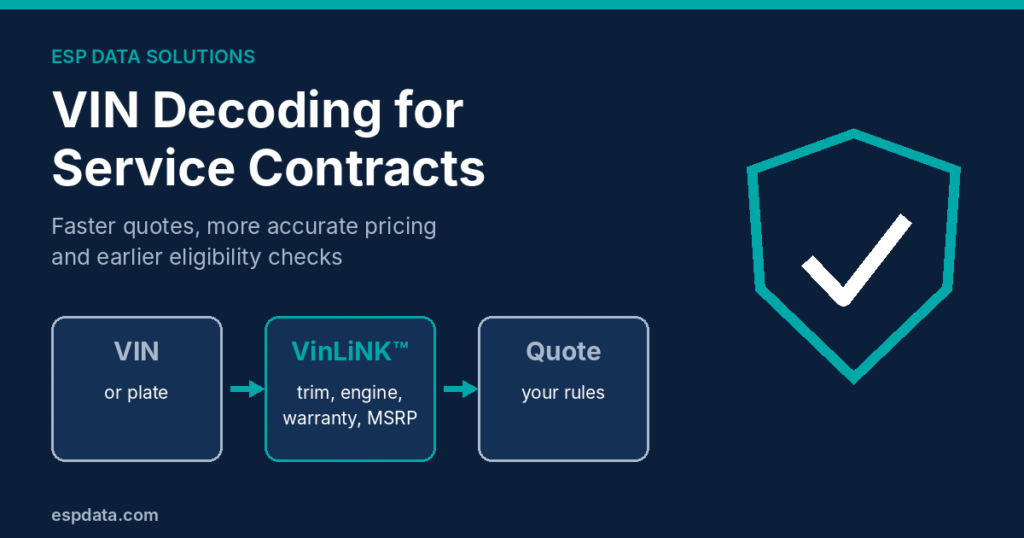
Here’s how the data fits into a typical quoting workflow:
- The VIN arrives. A dealer’s F&I system or an online quote form sends the VIN, or a license plate that Plate-to-VIN converts into a VIN.
- VinLiNK™ decodes it. The API returns model year, make, model, available trim and engine details, and, with Basic Plus, manufacturer warranty and MSRP data.
- Your rating system takes over. It combines that vehicle data with mileage, vehicle age, coverage terms, and your own claims history.
- The quote goes out. Your program rules decide eligibility and price, and the customer sees an offer without manual vehicle lookups.
What VinLiNK™ Provides vs. What Your VSC System Decides
VinLiNK™ supplies the vehicle data. Your service contract system applies the rules. Here’s how each data point typically maps to a decision:
- Model year, make, and model: Your system uses them for initial vehicle identification and age-based eligibility rules.
- Trim and engine: Your system uses them to assign the right rating class.
- Manufacturer warranty information (Basic Plus): Your system uses it, together with mileage and in-service date, to evaluate possible coverage overlap.
- MSRP, dimensions, and weight (Basic Plus): Your system can apply them as additional rating factors.
- Recall campaigns (Recall Report): Your system can flag them for further review. They don’t confirm whether a repair has been completed.
Which VinLiNK™ Report Fits Your Program?
- Basic ($0.20 per report): Year, make, model, and trim data, NHTSA-required manufacturer data, and ACES mapping. A good fit for fast quote forms.
- Basic Plus ($0.25 per report): Everything in Basic, plus dimensions and weight, manufacturer warranty, and MSRP. A useful option when warranty, MSRP, dimensions, or weight are required in the quoting workflow.
- Enhanced ($0.50 per report): Everything in Basic, plus technical specs such as horsepower and torque, and standard and optional equipment. Useful when your rating model uses detailed equipment data.
- Recall ($0.25 per report): Everything in Basic, plus manufacturer recalls.
Prices are taken from the VinLiNK™ pricing page as of November 2026, and prices and terms may change. ESP’s VinLiNK™ product page notes no contracts or monthly fees. Accounts work on prepaid funds with a $100 minimum deposit, and funds need to be used within a year.
Let Customers Quote With a License Plate
Many consumers don’t know their VIN, but they know their plate. Plate-to-VIN uses a U.S. license plate and registration state to return the matching VIN found in available records, which VinLiNK™ can then decode. Plate-to-VIN covers all 50 states, though a lookup may also return no match. It returns vehicle data only, with no owner or personal information. That makes it a simple way to shorten online quote forms and potentially reduce friction during quoting, the same approach we described for trade-in forms.
If your rating platform must run inside your own network, VinPOWER is ESP’s separate on-premises decoder for .NET and Java environments.
Frequently Asked Questions
Can VIN decoding speed up service contract quotes?
Yes. Decoding the VIN populates year, make, model, and available trim and engine details automatically, so dealers and customers can get a quote without manual vehicle lookups.
Can VIN decoding help determine service contract eligibility?
Yes, as part of the process. VIN decoding supplies the vehicle data your eligibility rules need, such as model year, vehicle type, and engine. The final decision still depends on your program’s rules, mileage, vehicle age, and other information you collect.
Can we decode our whole contract portfolio at once?
Yes. ESP states that VinLiNK™ can process batch jobs of up to 250,000 VINs. You submit a file and retrieve the results once processing is complete.
Can customers start a quote with a license plate?
Yes. Plate-to-VIN converts a U.S. plate and state into a VIN, so customers can begin a quote without finding their VIN. Match rates vary by state and record availability, so the quote flow should keep a VIN-entry fallback.
Does VinLiNK™ include factory warranty information?
Yes. The Basic Plus report includes manufacturer warranty and MSRP data for $0.25 per report. Combined with mileage and in-service date, it helps you evaluate potential overlap with the factory warranty.
Start Quoting Smarter With VinLiNK™
VIN decoding for service contracts can help providers streamline quoting, improve rating accuracy, and make more informed eligibility decisions. See how VinLiNK™ fits into your workflow: request a free VinLiNK™ testing account and test the API with your own VINs, or call ESP Data Solutions at (978) 975-3333. ESP has provided vehicle data for more than 30 years, and VinLiNK™ has decoded more than one billion VINs.