
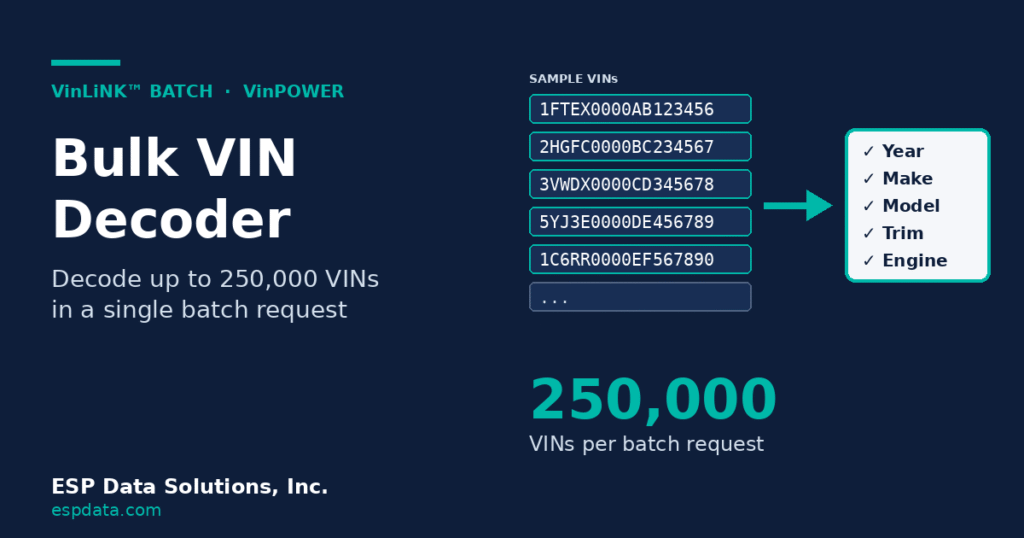
A bulk VIN decoder turns a long list of Vehicle Identification Numbers into structured vehicle data in one pass. Instead of looking up VINs one at a time, you submit a list and receive structured vehicle data, such as year, make, model, trim, and engine, for the records that can be decoded. Invalid or unresolved VINs may require validation or follow-up review.
For insurers, lenders, fleets, and dealer groups, bulk decoding matters whenever policy books, loan portfolios, inventory files, or fleet records need to be reviewed and standardized.
Who Needs a Bulk VIN Decoder?
Any organization that holds thousands of VINs can benefit from decoding them in bulk:
- Insurance carriers and agencies reviewing a policy book before renewals or rate changes
- Banks, credit unions, and auto finance companies reviewing collateral across a loan portfolio
- Fleet operators and leasing companies standardizing vehicle records across locations
- Dealer groups cleaning up inventory and service-customer data
- Analytics and marketing teams enriching customer or market data with vehicle details
In each case, the goal is the same: replace incomplete or inconsistent free-text vehicle descriptions with consistent, decoded vehicle data.
How Bulk VIN Decoding Works
A typical bulk decoding project follows five simple steps:
- Export your VIN list from your policy, loan, fleet, or dealer management system.
- Check the list for obvious errors, such as incorrect length or the letters I, O, or Q, which are not used in the standardized 17-character VINs assigned to model-year 1981 and newer vehicles for the U.S. market.
- Choose the report level your team needs, from core identification to deeper specifications or recall data.
- Submit the file for decoding.
- Match the results back to your records using the VIN as the key, then review any VINs that could not be decoded.
For vehicles subject to U.S. VIN requirements under 49 CFR 565.15, the ninth position is a check digit used to help verify VIN transcription, so a good decoder can also help flag VINs that were typed incorrectly. Those records can then be corrected at the source.
Bulk VIN Decoding With VinLiNK™ Batch Decoding
VinLiNK™ batch VIN decoding from ESP Data Solutions is designed for exactly this kind of project. You can submit up to 250,000 VINs in a single request and receive the results as a packed response file.
Each batch can use the same report levels as VinLiNK™:
- Basic: Year, make, model, trim, engine, and other core vehicle attributes
- Basic Plus: Adds MSRP data, weights and dimensions, and warranty information where available
- Enhanced: Adds deeper manufacturer technical details
- Recall: Adds manufacturer recall and safety campaign data associated with the decoded vehicle
Field availability varies by VIN, vehicle type, model year, source data, and selected report. Recall data shows the campaigns associated with the vehicle and does not necessarily confirm whether a specific VIN’s repair is open or completed.
VinLiNK™ covers model years 1981 and newer across vehicle types, so one batch can handle a mixed portfolio of cars, trucks, SUVs, and other vehicles.
Free Decoders vs. a Commercial Bulk VIN Decoder
Free public VIN decoders can work well for basic, smaller tasks. Some public batch tools accept only small groups of VINs per request, such as 50, which suits quick checks rather than full portfolios. Others offer downloadable databases, but your team then needs to host and maintain the data itself. For a detailed side-by-side look, see our VIN decoder API comparison.
A commercial bulk VIN decoder is built for production workloads:
- Volume: Up to 250,000 VINs per VinLiNK™ batch request instead of many small calls
- Data depth: Report levels from core identification to MSRP data, specifications, and recall data
- Industry mapping: ACES mapping support for parts and service workflows
- Pre-processing validation: The VinLiNK™ batch workflow reports the number of valid and invalid VINs before charges are applied, so your team can clean the list first
- Deployment choice: Cloud batch decoding or on-premises decoding with VinPOWER
- Support: Account-level support for teams implementing production workflows
When to Choose VinPOWER Instead
Some organizations decode very large volumes every day or prefer to keep all decoding inside their own environment. For those teams, VinPOWER offers on-premises VIN decoding that runs within your own systems.
A simple way to decide:
- Choose VinLiNK™ batch decoding for periodic projects, such as quarterly portfolio reviews or year-end policy cleanups.
- Choose VinPOWER when decoding is part of your daily, high-volume operations and you want it in-house.
The ESP Data Solutions team can help you compare both options for your volumes and systems.
Bulk VIN Data Quality Checklist
Before starting a bulk decoding project, use this checklist to prepare and review your VIN data. A bulk VIN decoder can help you:
- Fill in missing fields, such as trim, engine, or body style
- Standardize descriptions, so the same vehicle looks the same across every system
- Find invalid VINs that need correction at the source
- Add recall campaign data to support additional research and follow-up review
- Recognize current model-year codes, such as “V” in the 10th position for model year 2027 under current U.S. VIN rules
Frequently Asked Questions
Can I decode thousands of VINs at once?
Yes. VinLiNK™ batch decoding accepts up to 250,000 VINs in a single request, so most portfolios can be decoded in one or a few submissions.
What vehicle data does a bulk VIN decoder return?
With VinLiNK™, results can include year, make, model, trim, engine, and other core attributes. Higher report levels add MSRP data, specifications, warranty information, and recall data where available.
What happens to invalid VINs in a batch?
Your list is validated first. Before processing, the VinLiNK™ batch workflow reports the number of valid and invalid VINs, so your team can correct the source records before submitting the charged decoding job. Ask ESP about per-record error output and resubmission options for your specific workflow.
Does bulk decoding include recall information?
Yes. You can choose the Recall report level to add manufacturer recall and safety campaign data associated with each decoded vehicle. To confirm whether a specific VIN’s repair is still open, check with the manufacturer.
Which vehicles can be decoded in bulk?
VinLiNK™ covers model years 1981 and newer across vehicle types, including cars, light trucks, and SUVs.
Can bulk VIN decoding run inside our own systems?
Yes. VinPOWER provides on-premises VIN decoding for organizations that prefer to keep high-volume decoding in-house.
Start Using a Bulk VIN Decoder Built for Business
Whether you manage a policy book, a loan portfolio, or a national fleet, a bulk VIN decoder turns a long VIN list into consistent, usable vehicle data. With VinLiNK™ batch decoding for large projects and VinPOWER for in-house volume, ESP Data Solutions can support both.
Contact ESP Data Solutions to discuss your VIN list and find the right bulk decoding option for your team.
Last reviewed: November 2026.